For example, window boxes work well for cookies and food gifts, rigid boxes suit luxury and corporate gift sets, corrugated mailer boxes are better for ecommerce shipping, and kraft boxes are a practical choice for brands looking for a more natural or sustainable appearance.
If you’re sourcing Christmas packaging for a brand, retailer, food business, or corporate gifting program, this guide covers 10 Christmas gift box ideas based on real product applications. You’ll also learn how to choose the right box type, material, size, customization options, MOQ, and shipping solution for custom Christmas gift boxes and bulk holiday packaging orders.
Whether you need branded Christmas gift boxes for a retail campaign, custom holiday packaging for a product launch, or wholesale Christmas gift boxes for seasonal promotions, the right packaging structure should balance presentation, product protection, cost, and production requirements.
Which Christmas Gift Box Is Right for Your Product?
Here’s the honest shortcut. This table maps the most common products to a starting point:
Product | Recommended Box | Best Material |
Cookies | Window box | Food-grade paperboard |
Chocolate | Rigid box with tray | SBS paperboard |
Cosmetics / skincare | Rigid box (magnetic) | Greyboard + art paper |
Wine / beverages | Bottle box | Rigid board or corrugated |
Corporate gifts | Magnetic box | Rigid board |
Jewelry | Small rigid box | Greyboard + insert |
Ecommerce gifts | Mailer box | Corrugated board |
Sustainable gifts | Kraft box | Recyclable kraft paper |
One thing worth flagging before you commit: the box type usually dictates your minimum order quantity and lead time. Rigid boxes are handmade in stages, so their MOQ is typically higher than folding cartons or corrugated mailers. If you’re a smaller startup testing a Christmas line, a printed mailer or folding carton lets you launch at a lower quantity — then you can move up to rigid boxes once the SKU proves itself.
As a practical benchmark for your sourcing list, stock Christmas gift boxes are often offered in 6-pack, 9-pack, or 12-pack formats, and a common stock size is 8 x 8 x 4 inches. That makes it easier to compare what’s needed before moving to custom sizing.
Common Types of Christmas Gift Boxes
Before choosing a Christmas gift box design, it helps to understand the main box structures available. The right option depends on your product, budget, branding goals, and shipping requirements.
- Folding carton: A lightweight and cost-effective option for cookies, chocolates, cosmetics, and retail gift products.
- Rigid gift box: A premium structure commonly used for luxury products, corporate gifts, jewelry, and high-value gift sets.
- Magnetic closure box: A rigid box with a built-in magnetic flap that works well for premium skincare, corporate gifts, and curated gift sets.
- Window box: A folding carton with a clear or paper-based window that allows customers to see cookies, chocolates, or other food products.
- Corrugated mailer box: A stronger structure designed for ecommerce and direct-to-consumer shipping.
- Drawer box: A slide-out box structure suitable for cosmetics, jewelry, chocolates, and premium gift sets.
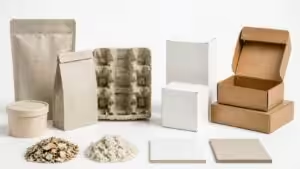
- Kraft gift box: A paper-based option often chosen by brands looking for a natural, simple, or sustainability-focused appearance.
Once you know the basic structures, it’s easier to match the box to the product and your Christmas campaign requirements.
10 Christmas Gift Box and Gift Basket Ideas for Different Products
Christmas Cookie Gift Box
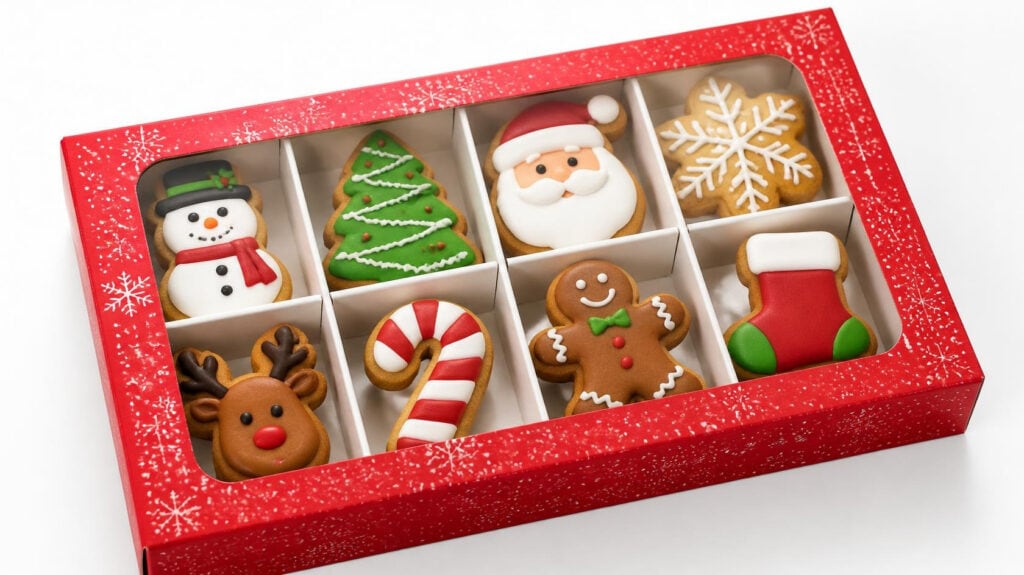
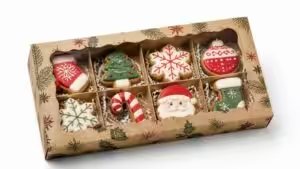
Cookies sell on appetite appeal, so let people see them. In broader holiday assortments, a christmas gift box with cookies is often paired with other gourmet items and may stay fully sweet or add a savory contrast. A window box in food-grade paperboard works beautifully — add a die-cut window (with or without a clear film liner) and a simple divider to keep cookies from sliding into one messy pile during transit.
- Best box type: Window box or two-piece lid-and-base
- Material: Food-grade SBS paperboard
- Window & divider: Yes — protects presentation and product
- Best for: Bakeries, snack brands, holiday gift sets
Chocolate Gift Box
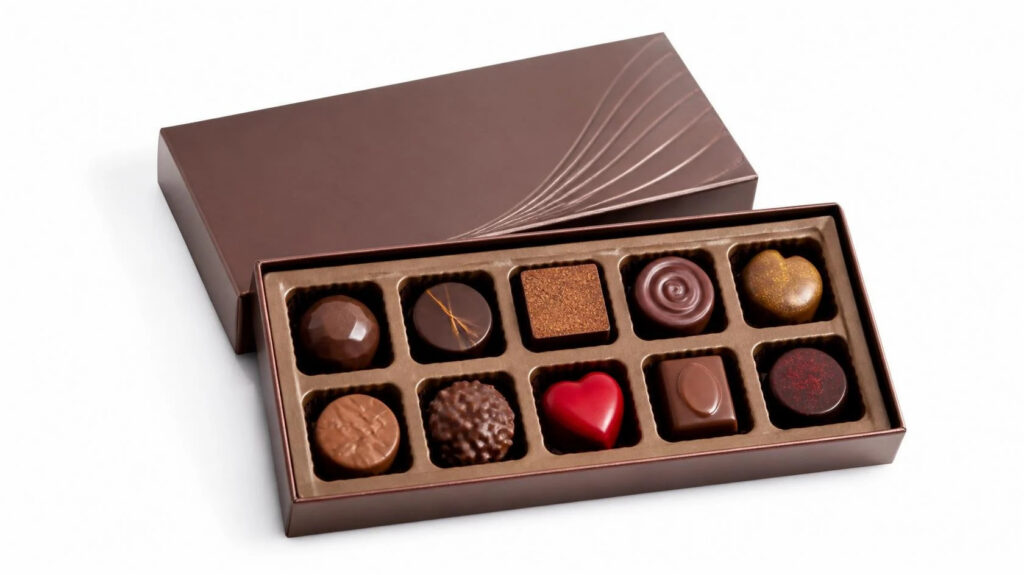
Chocolate is fragile and heat-sensitive, so structure matters more than looks here. A rigid box with a molded paper or vacuum-formed tray keeps each piece in place. If you’re selling into supermarkets, a matte or soft-touch finish reads as “premium” instantly.
- Best for: Chocolatiers, confectionery brands, corporate gifting
Wine and Beverage Gift Box
A wine box has to do one job perfectly: keep the bottle from moving. We usually recommend a rigid bottle box or a sturdy corrugated carton with a snug insert. Single-bottle presentation boxes suit gifting; multi-bottle corrugated designs suit shipping.
- Best for: Wineries, spirits brands, gift retailers
Beauty and Skincare Gift Set

Beauty buyers expect a premium unboxing. A magnetic-closure rigid box with a foam or paper insert holds bottles and jars securely and photographs well for social media — which matters more than people admit for DTC beauty.
- Best for: Cosmetic startups, skincare brands, subscription boxes
Luxury Christmas Gift Box
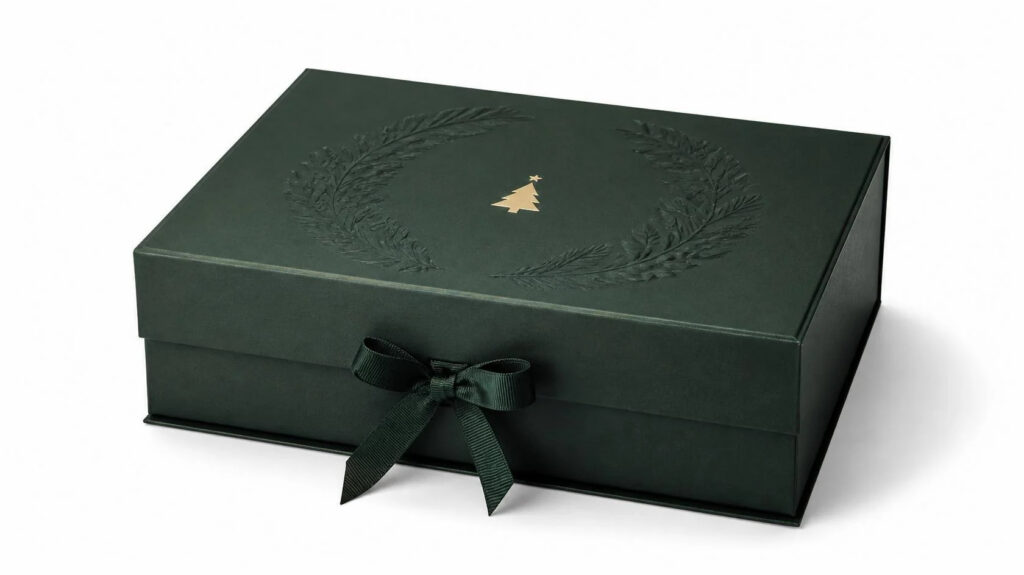
When the packaging itself needs to communicate premium value, use a rigid box and add one or two carefully selected finishes, such as foil stamping, embossing, or a soft-touch laminate.
One practical rule: luxury usually comes from restraint. A clean dark-green box with a single gold-foil logo can often look more premium than a design crowded with multiple finishes and competing graphics.
- Best for: Premium brands, high-value hampers, VIP client gifts
Corporate Christmas Gift Box
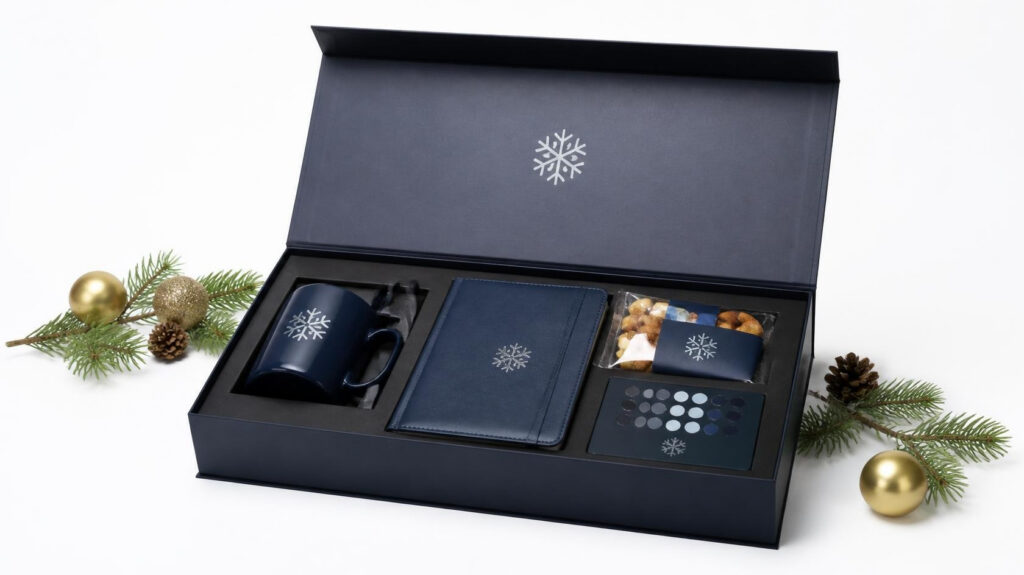
Corporate gifting is where brands get judged, so consistency beats flash. A magnetic rigid box with a clean insert lets you build a themed gift concept or combine fun items, useful items, cozy items, and tasty treats — like a mug, a notebook, and a snack — without the contents rattling around. You can also design these Christmas boxes to share during team quality time or family gatherings, with interactive options such as simple games or crafts. Keep the branding subtle and the logo sharp; these boxes often land on a client’s desk, not in a bin.
- Best for: B2B brands, agencies, HR and client-gifting programs
Advent Calendar Gift Box
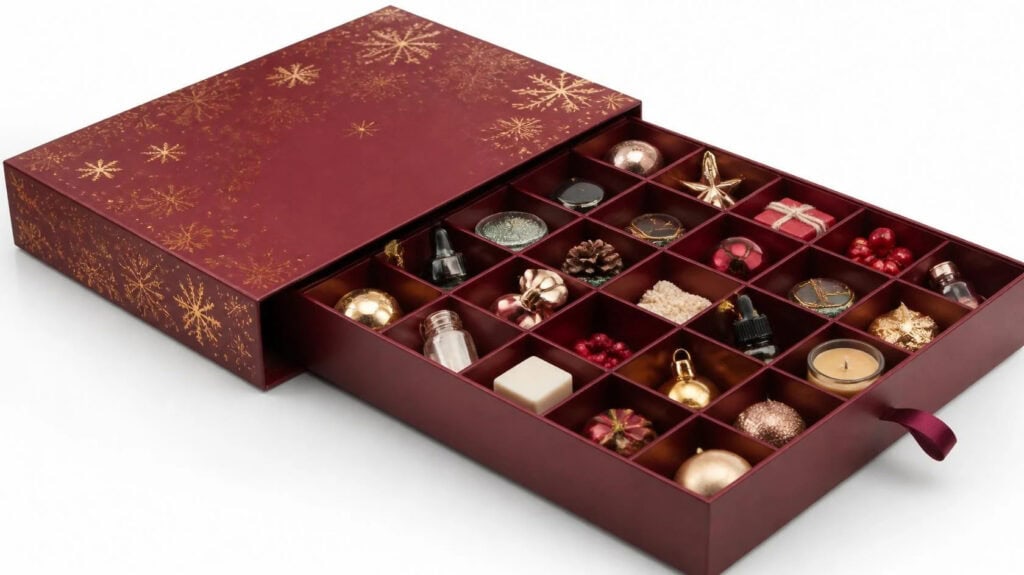
Advent calendars are fun to sell and tricky to build. You’re essentially designing 24 little compartments that all have to survive shipping. A rigid box with a printed paper insert tray (or drawer-style structure) works best. Plan the die-line early — this is the one product where structural design mistakes get expensive fast.
- Best for: Beauty, chocolate, tea, and pet-snack brands
Jewelry Gift Box
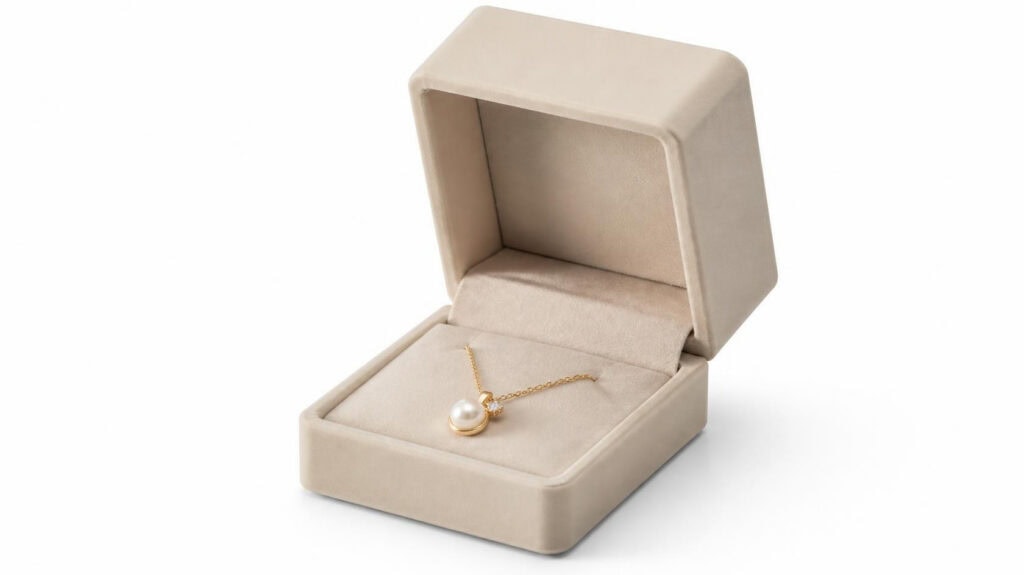
Small product, big expectations. Jewelry buyers judge quality by weight and finish, so a small rigid box with a foam or velvet-feel insert does the heavy lifting. Even a modest piece feels premium in a well-made box — which is exactly why the packaging pays for itself here.
- Best for: Jewelry brands, accessory startups, personalized gift sellers
Ecommerce Christmas Gift Box
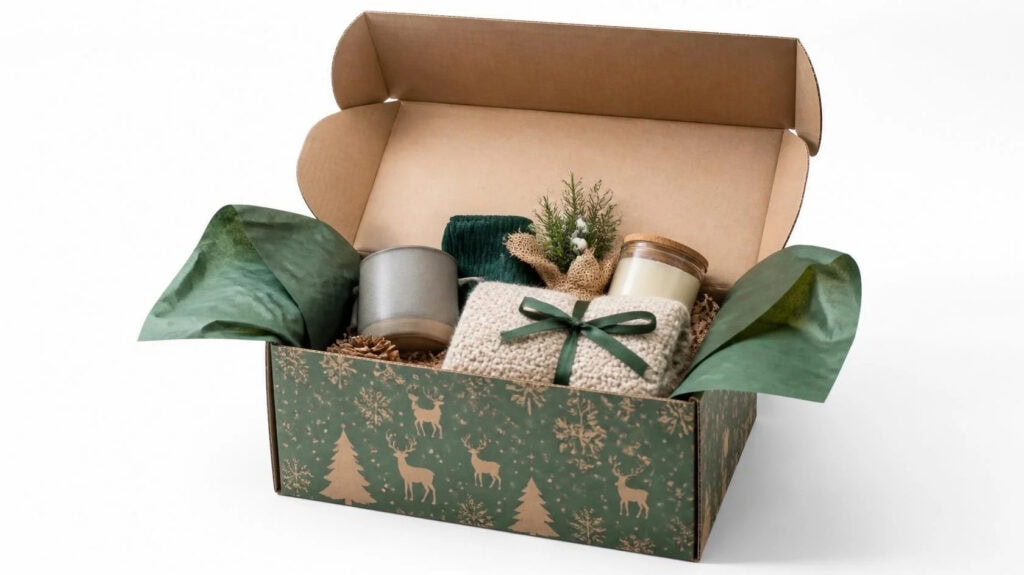
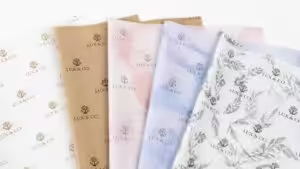
For online orders, the box has to look good and ship well with no extra outer carton. A corrugated mailer box with a festive print and a tissue-paper wrap is easy to assemble, can be stored flat before use, and gives that “gift-worthy” unboxing while surviving the courier network. This is usually the most cost-effective route for DTC brands.
- Best for: Online stores, subscription boxes, direct-to-consumer brands
Sustainable Christmas Gift Box

Eco matters more every year, especially for brands selling into the EU where plastic rules keep tightening. Choose recyclable kraft or uncoated paperboard, skip plastic windows in favor of paper-based alternatives, and use soy-based inks where possible. “Sustainable” also sells — a lot of shoppers now actively look for it at Christmas.
- Best for: Eco-conscious brands, natural food and beauty lines
Christmas Gift Boxes Design Ideas for 2026
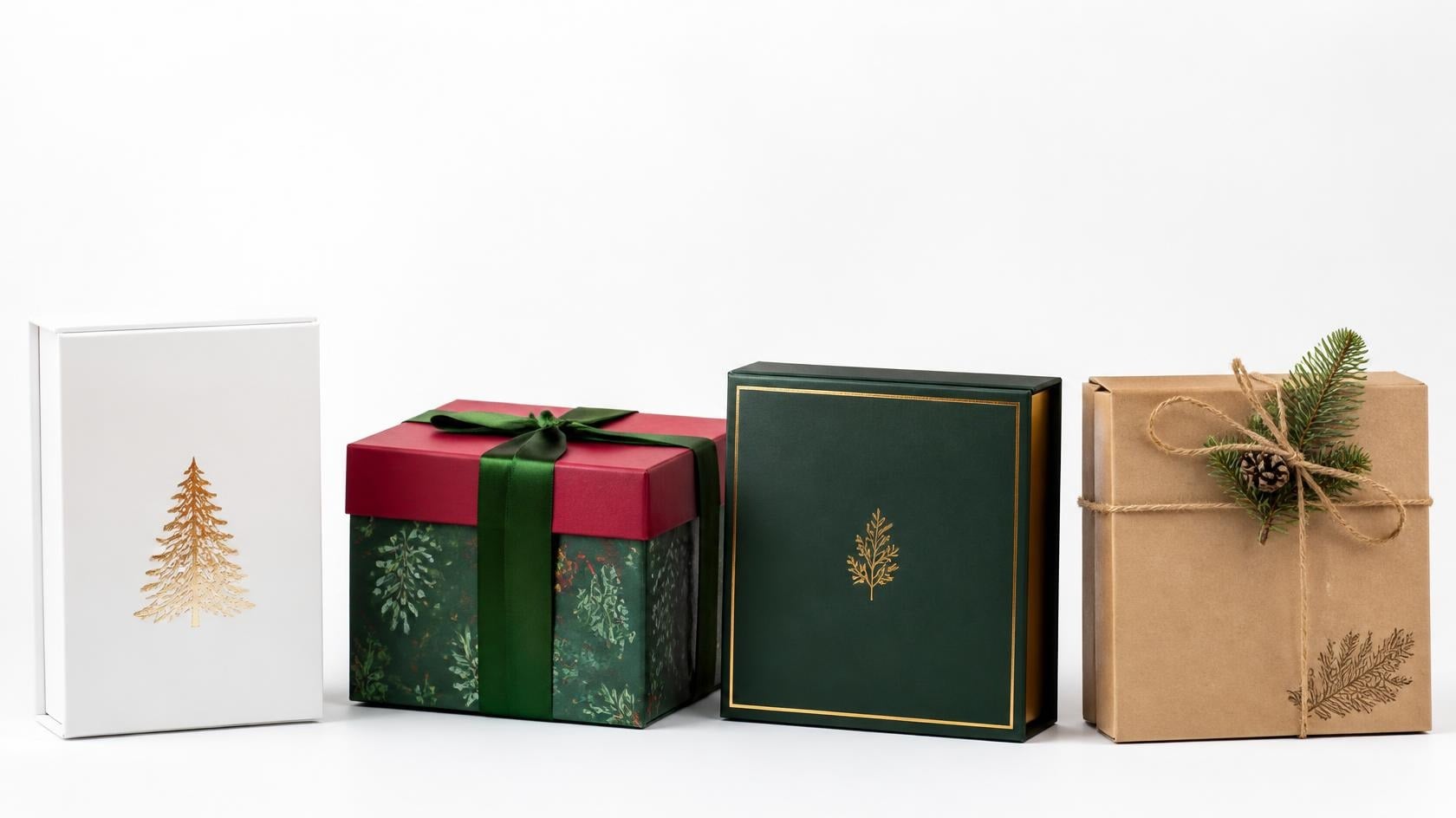
Festive design is shifting away from loud and busy toward calm and premium. If you’re planning artwork now, here’s where the market is heading:
- Minimalist Christmas packaging — plenty of white space, one clear focal point, and a single foil accent. It reads as expensive and prints cleanly.
- Red and green classics — still the safest choice for supermarket shelves and mass gifting; a classic palette that’s instantly recognizable as Christmas.
- Dark green and gold — the go-to combination for premium and luxury lines. It photographs beautifully for DTC unboxing content and has the same timeless appeal.
- Kraft and natural tones — perfect for eco and artisan brands, and it pairs well with the sustainability angle EU buyers increasingly ask for.
- Personalized packaging — names, short messages, or “limited edition” text. Great for gifting brands, and pairing it with a consistent color theme usually makes the design feel more cohesive, though it can push up printing cost and MOQ, so plan it deliberately.
A practical tip from years of print jobs: dark colors and gold foil look stunning on screen but are unforgiving in production. Get a physical pre-production sample before you approve a full run — a color that looks rich on your monitor can shift once it’s printed on real board. Seeing and touching the box first saves you from a very costly surprise across thousands of units.
Christmas Gift Box Customization Options
Custom Christmas gift boxes can be adjusted based on the product, branding requirements, and budget. The most common customization options include:
Custom Option | What It Does | Best For |
Custom size | Matches the box to the product dimensions | All product types |
Custom printing | Adds brand colors, graphics, and seasonal designs | Retail and branded gift boxes |
Foil stamping | Adds a metallic premium effect | Luxury and corporate gifts |
Embossing | Creates raised logo or graphic details | Premium branding |
Spot UV | Highlights selected logos or design elements | High-end retail packaging |
Window | Allows customers to see the product | Cookies and food gifts |
Inserts | Holds products securely in position | Cosmetics, chocolates, and gift sets |
Dividers | Separates multiple products | Cookie, chocolate, and corporate gift sets |
Ribbon or handle | Improves gift presentation or carrying convenience | Premium gift boxes |
The best approach is to select customization features based on the product and budget rather than adding every available finish. A simpler box with the right structure and one strong finishing detail can often deliver a better result than an over-designed package.
How to Choose the Right Christmas Gift Box Sizes
Sizing is where most Christmas orders quietly go wrong.
As a simple starting formula:
Internal box size = product dimensions + protective clearance + insert thickness + wrapping material.
The exact allowance depends on the product and packaging structure, but the box should not be sized only according to the raw product dimensions.
Buyers measure the product, order a box to match — and forget that inserts, tissue paper, and a little breathing room all take up space too.
Here’s the simple way to get it right:
- Measure the product at its widest points (length × width × height).
- Add space for protection — usually 3–5 mm of clearance on each side so the product isn’t jammed in.
- Account for the insert — a molded tray, divider, or foam adds real thickness.
- Add the tissue paper wrap if you’re using one for presentation.
- Check shipping fit — if it’s an ecommerce box, confirm the finished size still suits your courier’s pricing tiers.
A quick example. Say you’re boxing a skincare set: a serum bottle (5 × 5 × 12 cm) plus a small jar (6 × 6 × 5 cm), sitting side by side.
- Products side by side ≈ 11 cm wide × 6 cm deep × 12 cm tall
- Add 4 mm clearance all around → roughly 11.8 × 6.8 × 12.4 cm
- Add a paper insert wall between the two items → about 12.5 × 7 × 12.5 cm
So your finished internal box size lands near 12.5 × 7 × 12.5 cm — not the 11 × 6 × 12 cm the raw product measurement suggested. That small gap is exactly what stops products from rattling loose or looking cramped when the customer opens the lid.
If sizing feels fiddly, send us the products or their exact dimensions and we’ll work back the die-line and insert for you — it’s part of the structural design we do before any sample is made.
What Drives the Cost of a Christmas Gift Box
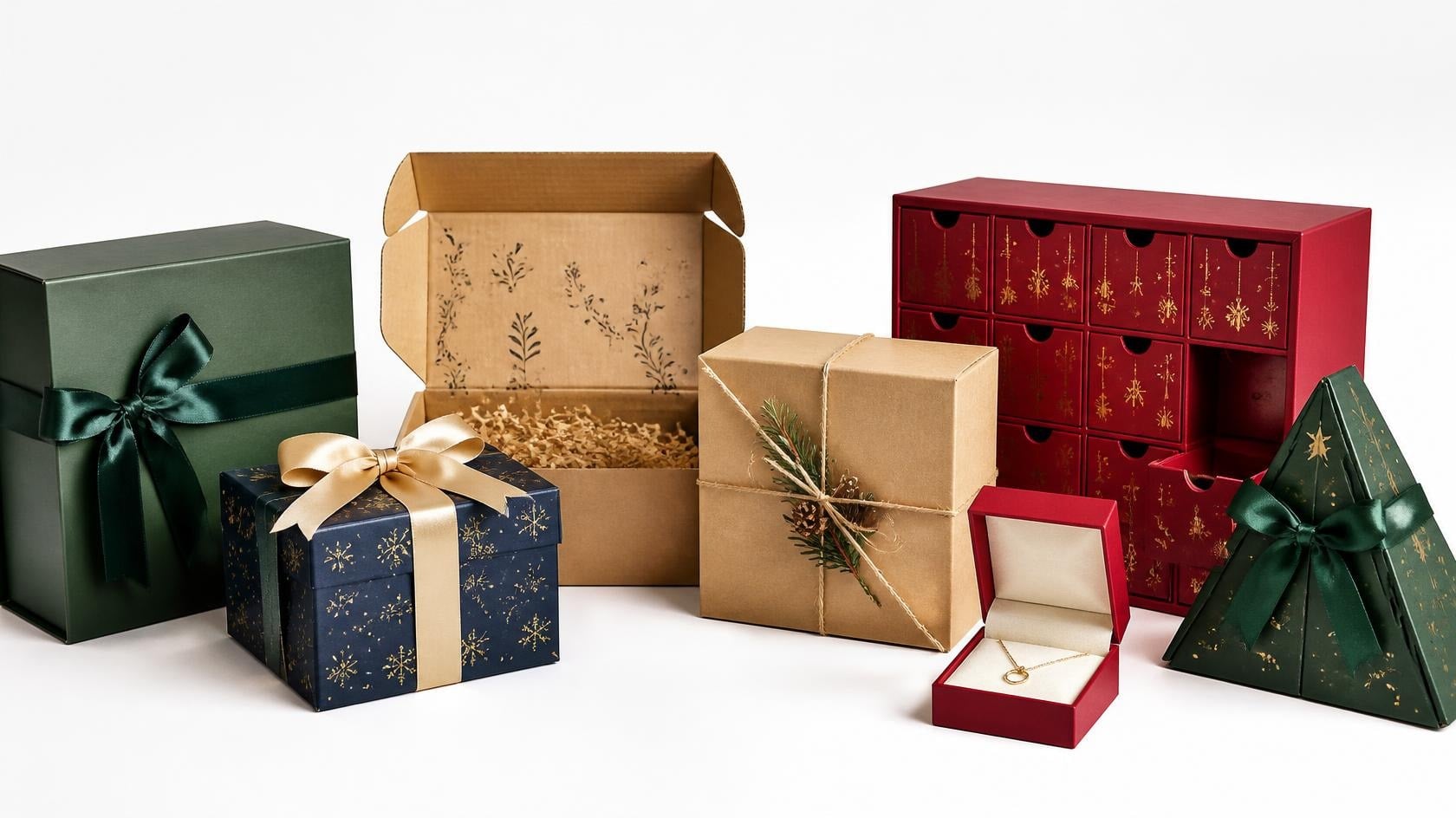
If you’ve ever received two wildly different quotes for what looks like the “same” box, this is why. A gift box price isn’t one number — it’s the sum of a few choices, and each one moves the needle:
- Box type — folding cartons and mailers are cheaper; rigid boxes cost more because they’re assembled by hand in stages.
- Material — food-grade board, greyboard thickness, and paper weight all affect price and feel.
- Printing — one or two colors is economical; full-color CMYK with tight registration costs more.
- Finishing — foil stamping, embossing, spot UV, and soft-touch laminate each add a line to the invoice.
- Inserts — molded pulp, foam, or die-cut paper dividers add material and labor.
- Order quantity — this is the big one. Unit price drops sharply as volume rises.
The single most useful cost tip I can give you: decide your finishes before you commit, not after. Adding foil or a special insert once artwork is approved usually means re-quoting and re-sampling — which burns days you don’t have during a Christmas run. Lock the spec early and the whole timeline stays calm.
For startups, keep it simple: one strong print, one nice finish, a lower-MOQ box type. For wholesale retailers, the smart move is ordering volume on a slightly simpler structure — you get shelf impact and a better unit price than over-engineering a small run.
Choosing the Right Materials and Finishes
Material choice comes down to two questions: what’s the product, and how premium should it feel?
- Food products need food-grade paperboard — non-negotiable if you’re selling into the EU (food contact safety standards) or the US (FDA regulations). Always confirm this in writing with your supplier.
- Premium and luxury lines suit rigid greyboard wrapped in printed art paper — the weight alone signals quality.
- Eco-focused brands do well with recyclable kraft and paper-based windows instead of plastic film.
On finishes, pick for effect, not for the sake of it:
- Soft-touch laminate → understated premium feel
- Gold or silver foil → festive, gift-worthy shine
- Embossing → tactile logo detail
- Spot UV → contrast and highlight on a matte base
One honest note: more finishes don’t equal more premium. Two well-chosen finishes almost always beat five competing ones.
Making Sure Your Boxes Survive Shipping
This is the part that gets overlooked until a pallet arrives dented — and by then it’s too late for the season. Christmas stock often travels by sea for weeks, through humidity and rough handling, so the box has to be planned for the journey, not just the shelf.
A few things that genuinely prevent damage:
- Match board strength to the trip. Long sea freight and heavy stacking need sturdier board or an outer corrugated carton around retail boxes.
- Mind the moisture. Humidity during ocean transit can soften board and lift laminates. For food and beauty goods especially, a moisture-resistant coating or a desiccant in the master carton is cheap insurance — a problem I’ve seen catch out more than one first-time exporter.
- Protect the corners and lids. Rigid box lids and foil edges scuff easily; snug inner packing and proper master-carton fit stop that in-transit rubbing.
- Test before you scale. A pre-shipment drop or stacking check on a sample is far cheaper than replacing a damaged container of finished goods.
Build the packaging for the whole journey — factory, ocean, warehouse, shelf — and you avoid the most expensive Christmas mistake there is: beautiful boxes that don’t arrive beautiful.
Christmas Gift Box Buying Checklist for Businesses
Before requesting a quote from a packaging supplier, prepare the following information:
- Product dimensions: Measure the finished product at its widest points.
- Box structure: Decide whether you need a folding carton, rigid box, magnetic box, drawer box, or corrugated mailer.
- Material: Choose between paperboard, greyboard, kraft, or corrugated board based on the product and shipping requirements.
- Insert requirements: Specify whether you need dividers, trays, or paper inserts.
- Printing requirements: Confirm CMYK, Pantone colors, or special finishes such as foil stamping or embossing.
- Order quantity: Your target quantity can affect the available box structure and unit price.
- Sample requirements: Decide whether you need a structural sample or pre-production sample before full production.
- Production timeline: Leave enough time for artwork approval, sampling, production, and shipping.
- Shipping method: Confirm whether the box will ship directly to customers or inside an outer master carton.
Preparing these details before requesting a quote can reduce back-and-forth communication and help suppliers recommend a more suitable packaging solution.
Frequently Asked Questions About Christmas Gift Boxes
Q1: What is the minimum order quantity for custom Christmas gift boxes?
It depends on the box type. Folding cartons and corrugated mailers usually start lower — often a few hundred units — while rigid boxes carry a higher MOQ because they’re assembled by hand. If you’re testing a new Christmas SKU, start with a lower-MOQ box type and scale up once it sells. These boxes can also be curated for different recipients, including children with festive pajamas or small toys.
Q2: How far in advance should I order Christmas gift boxes?
Earlier than most people think. For custom printing, sampling, production, and sea freight, plan 3–4 months ahead of when you need stock in hand. Peak-season factory queues and shipping delays are the two things that quietly wreck Christmas launches — building in buffer time is the easiest way to protect your season.
Q3: Can I get a sample before placing a full order?
Yes, and you should. A pre-production sample lets you check color, finish, structure, and fit before committing to a full run. Screen colors — especially deep greens and gold foil — can shift once printed on real board, so approving a physical sample first prevents costly surprises.
Q4: Are your Christmas gift boxes food-safe?
For food products we use food-grade paperboard that meets relevant food-contact standards. If you’re selling into the EU or US, always confirm the material’s compliance in writing, since requirements differ by region.
Q5: Which box is best for shipping gifts directly to customers?
A printed corrugated mailer box is usually the best fit for ecommerce. It gives a gift-worthy unboxing while being strong enough to survive the courier network without an extra outer carton.
Q6: What is the best material for a Christmas gift box?
The best material depends on the product and how the box will be used. SBS paperboard works well for printed folding cartons, greyboard is commonly used for premium rigid boxes, corrugated board is better for ecommerce shipping, and kraft paperboard suits brands looking for a more natural or sustainability-focused option.
Q7: What size should a Christmas gift box be?
The internal box size should be based on the product dimensions plus the space required for protective clearance, inserts, dividers, and wrapping materials. Avoid sizing the box only according to the product’s exact dimensions, as this can cause a tight fit or make the product difficult to remove.
Q8: Are rigid Christmas gift boxes better than folding cartons?
Rigid boxes are generally better for premium presentation, luxury products, and corporate gifting. Folding cartons are usually more cost-effective, easier to store, and suitable for larger-volume retail programs. The better option depends on your budget, product value, order quantity, and shipping requirements.
Conclusion
The right Christmas gift box comes down to three things: the product you’re protecting, the feeling the customer gets when they open it, and how the box travels to get there. Match those, and everything else — material, finish, size, MOQ — falls into place.
Quick recap: window boxes for treats, rigid boxes for premium gifts, mailers for ecommerce, kraft for eco brands. Lock your finishes early, approve a sample, and plan around sea freight — not wishful timing.
Find the Right Christmas Gift Box Partner with Packoi
Sourcing Christmas packaging is a big decision, and timing matters. At Packoi, we help brands, wholesalers, and ecommerce sellers create custom Christmas gift boxes tailored to their products, budgets, and branding.
Send us your product dimensions or a reference photo. Our experts can recommend the best box structure, material, and finish — and prepare a sample before mass production.