
Here’s what I see all the time. A brand orders boxes by dimensions alone, then finds out the hard way that the shoes arrive crushed, or the shipping invoice comes back far higher than expected because the box was too big and DIM weight ate the margin. One of our US sneaker clients was overpaying on freight for months, simply because their box had two extra inches it didn’t need.
The tricky part is that shoe boxes are never one-size-fits-all — boots, kids’ shoes, and dress shoes each need their own dimensions, and buyers get tripped up daily by the gap between inside and outside measurements.
So in this guide, I’ll walk you through standard sizes by shoe type, exactly how to measure a box the right way, the inside-vs-outside difference that catches most people out, and how choosing the right size protects your product and trims your material and shipping costs on every order — whether you’re a startup placing your first run or a retailer ordering in bulk.
Why Shoe Box Dimensions Matter for Footwear Brands
Before we get to the size chart, let me explain why this matters so much. When your box dimensions are right, you protect your product, keep shipping costs down, and make your brand look sharp. When they’re off, you lose on all three — and usually all at once.
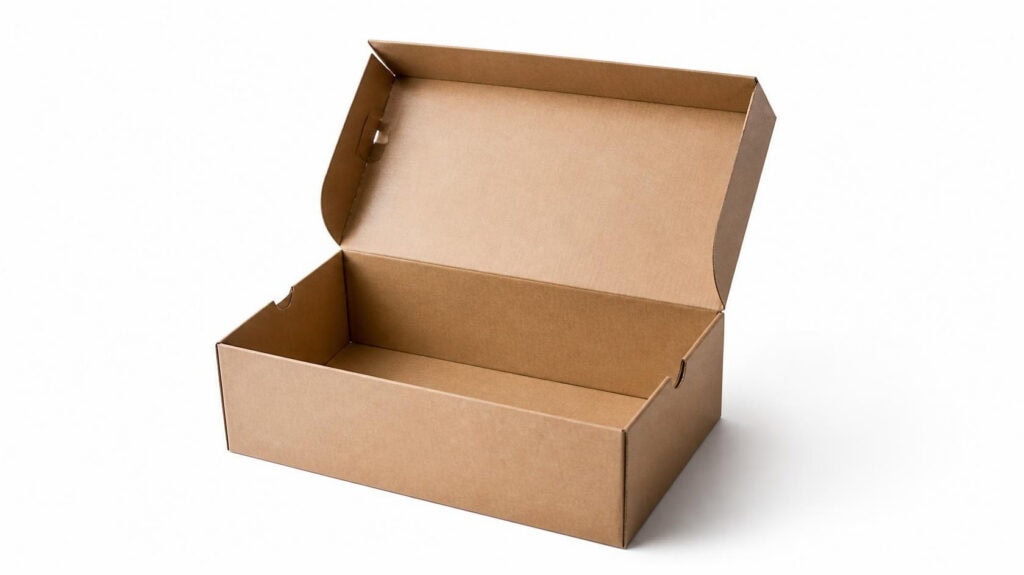
Protect Your Shoes in Storage and Transit
A box that’s too small forces the shoe into a shape it was never made to hold. Stack a few hundred of those in a warehouse or shipping container, and the pressure does the rest — crushed toe boxes, creased leather, scuffed uppers.
Here’s the part that hurts: the damage almost never shows at packing. It appears after transit, which means your customer sees it first, and the next thing you get is a return. Give the shoe proper clearance, and it arrives looking the way you intended.
Cut Your Packaging and Shipping Costs
Box size drives cost in a straight line:
Bigger box → more board → more space → higher DIM weight → higher freight.
Most carriers now bill on dimensional weight, not actual weight — so a light pair of sneakers in an oversized box gets charged as if it weighed far more. We had a US client who lost margin for months on exactly this, until we trimmed the box by a single inch. For DTC brands shipping every parcel individually, that small change adds up fast across a full catalog.
Improve the Unboxing Experience
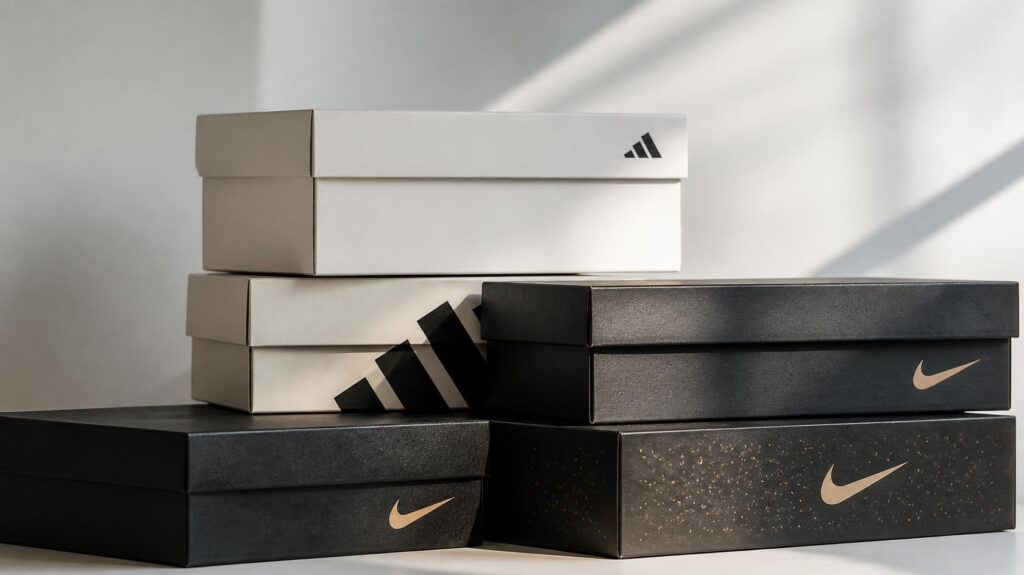
A box that fits cleanly — with just enough room for tissue or a dust bag — tells your customer the product inside is worth the price. One that rattles with empty space does the opposite. It’s no accident that brands like Nike and Adidas invest in clean, right-sized packaging: the fit is part of the impression.
Standard Shoe Box Dimensions by Shoe Type
There is no single “correct” shoe box size — dimensions vary by shoe style, size range, and how much protection the product needs. As a baseline, the average shoe box dimensions for adult footwear are about 13 × 7.5 × 4.5 inches. Still, most footwear falls into predictable size ranges, which makes the table below a useful starting point for planning packaging.
Shoe Type | Typical Shoe Box Dimensions (L × W × H) |
Athletic Shoes | 13 × 8 × 5 inches |
Running Shoes | 14 × 9 × 5 inches |
Casual Shoes | 14 × 9 × 5 inches |
High Heels | 12 × 8 × 4 inches |
Boots | 18 × 12 × 6 inches |
Kids Shoes | 10 × 7 × 4 inches |
Treat these figures as a starting point, not a fixed rule. The right dimensions for your product come down to a few things:
- Shoe size — a men’s US 13 needs noticeably more length than a women’s US 6. Across a full size run, that usually means you’ll need more than one box size, not just one. In most cases, a men’s shoe box is larger than a women’s shoe box, and boxes for children’s shoes are smaller than both.
- Shoe style — athletic shoes often need wider boxes to accommodate bulky soles, while flats sit lower and boxes for high heels may need extra height for heel elevation.
- Material — structured leather shoes need more clearance than soft, flexible fabric styles.
- Protective inserts — tissue paper, shoe trees, cardboard forms, or a dust bag all take up space you have to plan for upfront.
Here’s how we usually advise clients to handle it: size your box around the largest shoe in each SKU group(Stock Keeping Unit), then decide whether the added protection and freight savings are worth adding a second or third box size. For smaller startup brands, one well-chosen average shoe box can cover most of the range when the standard dimensions are close to your product mix. For larger wholesale programs, splitting into two or three standard shoe box sizes based on typical dimensions usually pays for itself in shipping.
How to Measure Shoe Box Dimensions Correctly
Most sizing problems start at measurement — and that’s also where you avoid them. The formula itself is simple:
Length × Width × Height
Length is the longest side (the way the shoe points), width is the shorter horizontal side, and height is the depth from base to lid. The hard part isn’t the math — it’s knowing which box you’re measuring.
Measure Inside Dimensions First
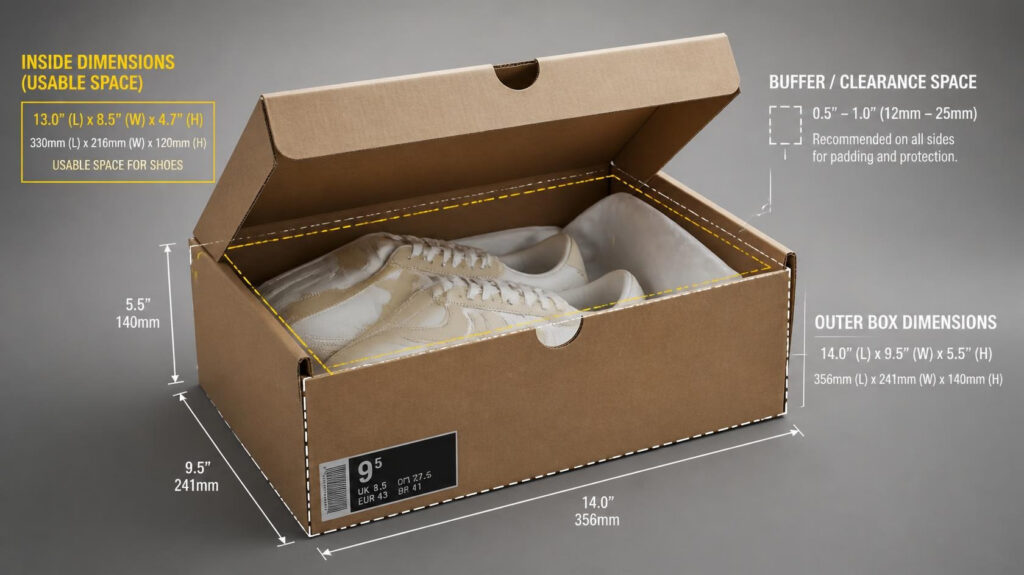
Inside dimensions account for the usable space inside the box. Measure the clear internal space — not the outer wall — because that’s the room your shoe, inserts, tissue paper, and the dimensions of a shoe actually have to share, and shoe box size should also leave about half to one inch of extra space for cushioning.
Size a box off its outer measurements and you’ll end up with less usable space than you expected. For example, a 2mm board thickness can reduce internal volume by about 1.2 inches overall, which is one of the most common reasons a box that looks “correctly sized” still crushes the shoe inside.
Measure Outside Dimensions for Shipping
Outside dimensions, or external dimensions, are what your warehouse and logistics planning run on. They drive:
- Master carton calculation — how many shoe boxes fit into an outer shipping carton
- Warehouse and pallet storage — how cleanly boxes stack and store
- Shipping quotes — carriers calculate DIM weight from the external size
Standard shoe boxes typically need 1 to 2 inches of extra space inside the shipping shoe box for protective packing. For any shipping shoe, the length width and height must match the required clearance so the pack stays protected in transit. Shoe box dimensions should also align with international shipping standards, and clear labeling helps warehouses identify contents quickly.
Because board thickness adds to every wall, outside dimensions are always larger than inside ones. If you need to measure a shoe box for freight, measure the outer walls, not the usable interior. That gap is exactly what trips buyers up when they’re calculating both fit and freight.
What We Account for as the Manufacturer
When we turn your requested size into a real, producible box, we factor in a few technical details on your behalf:
- Board thickness — corrugated and rigid boards add measurable bulk to each wall; thicker box walls improve protection against wear and tear, but they also affect fit, freight calculations, and material thickness changes both usable space and the outside footprint
- Folding structure — how the box folds affects both inside space and outside footprint
- Manufacturing tolerance — small, unavoidable production variances we plan around so the shoe always fits
Tell us your priority up front — fit, cost, or protection — and we can set the right dimensions instead of guessing.
Inside vs. Outside Dimensions: What Buyers Need to Know
This is the single most overlooked point in shoe box procurement, and it causes more sizing errors than anything else. A request like “I need a 14 × 9 × 5 box” is incomplete on its own — because it doesn’t say whether that’s the inside or the outside size.
Each measurement does a different job:
Dimension type | What it decides |
Inside | Whether the shoe and inserts actually fit |
Outside | How the box ships, stacks, and stores |
Here’s why it matters in practice. Give us “14 × 9 × 5” as an outside dimension, and once we deduct board thickness, the usable inside space is smaller — your shoes may not fit. Give the same number as an inside dimension, and the finished box comes out slightly larger outside, which changes your carton packing and freight.
Packoi Expert Tip:
When you request a quote, always state whether your numbers are inside or outside — and ideally send us the actual shoe dimensions and the largest size you need to fit. That lets us engineer the box around your product instead of working backward from a number that could be read two ways. Clarifying this one detail prevents a large share of fit and reorder problems. We’ve seen a single unclear spec cost a client an entire reorder cycle.
How Much Extra Space Should a Shoe Box Have?
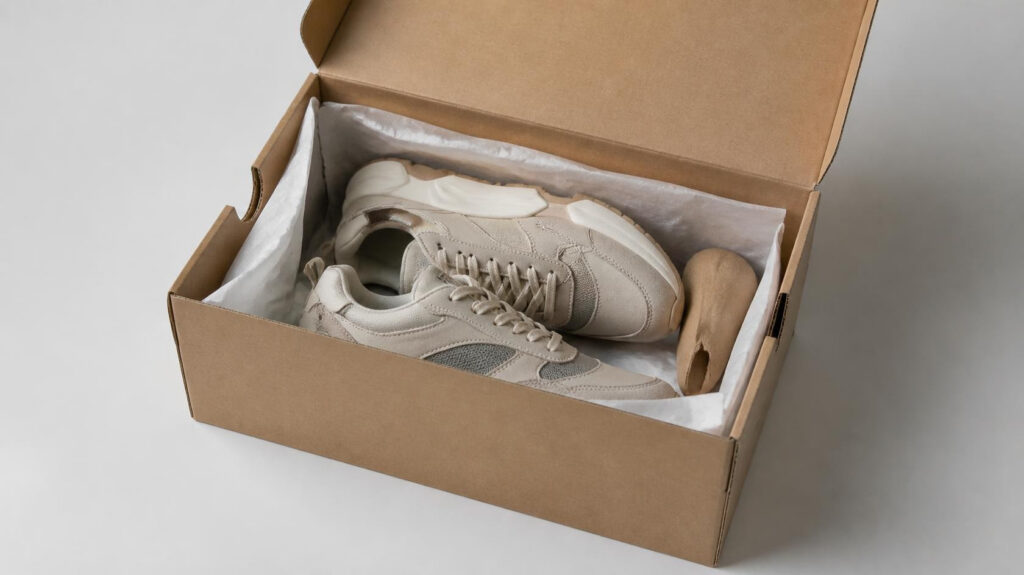
A shoe box should never fit the shoe perfectly. Some clearance is essential — both to protect the product and to make room for everything that shares the box with it:
- Tissue paper or wrapping
- Dust bags
- Cardboard forms or shoe trees
- Protective padding or inserts
As a general rule, allow around 0.5 to 1 inch beyond the shoe itself, then adjust for the shoe type and how much protection it needs.
Different styles call for different tolerances:
- Sneakers — usually need a small tolerance. They’re flexible and forgiving, so tight clearance keeps the box compact.
- Leather shoes — need more protective space. Rigid leather deforms easily under pressure, so extra clearance and padding help hold its shape.
- Boots — need extra height in particular. Tall shafts and structured ankles need vertical room so the boot isn’t bent or compressed.
The goal is a box that holds the shoe securely with just enough room for inserts — not so tight it strains the product, not so loose it shifts in transit.
Packoi Expert Tip:
The most common tolerance mistake we see is applying one clearance value across every style. Sneakers, dress shoes, and boots each behave differently under stacking pressure, and matching the tolerance to the shoe type is what prevents both crushing and wasted space.
Shoe Box Dimensions for Shipping and Storage
Beyond fit, dimensions decide how efficiently — and how affordably — your shoes move through the supply chain. This is where small sizing decisions turn into real logistics savings.
Box Size Affects DIM Weight
Carriers don’t bill on actual weight alone anymore. They also calculate dimensional (DIM) weight from the package’s volume, compare it with the shoe box weight of the packed box, and charge you the larger of the two figures.
Shoes are light for their size, so this hits hard. An oversized shoe box gets billed as if it weighed far more than it does — you’re paying for empty air on every parcel. Trim the box to the right dimensions and your box weight, freight, and the rate impact of how much the shoes weigh come down with it.
Optimize Carton Packing Efficiency
Individual shoe boxes are usually consolidated into master cartons for bulk shipping. How your box dimensions relate to the carton dimensions decides how many units fit per carton — and how much gap is wasted inside.
Efficient packing comes down to:
- Carton size — chosen so shoe boxes sit in clean rows and layers with minimal gaps
- Stacking — boxes that stack squarely resist crushing and use vertical space fully
- Container utilization — better carton fit means more units per pallet and per container, lowering freight per pair
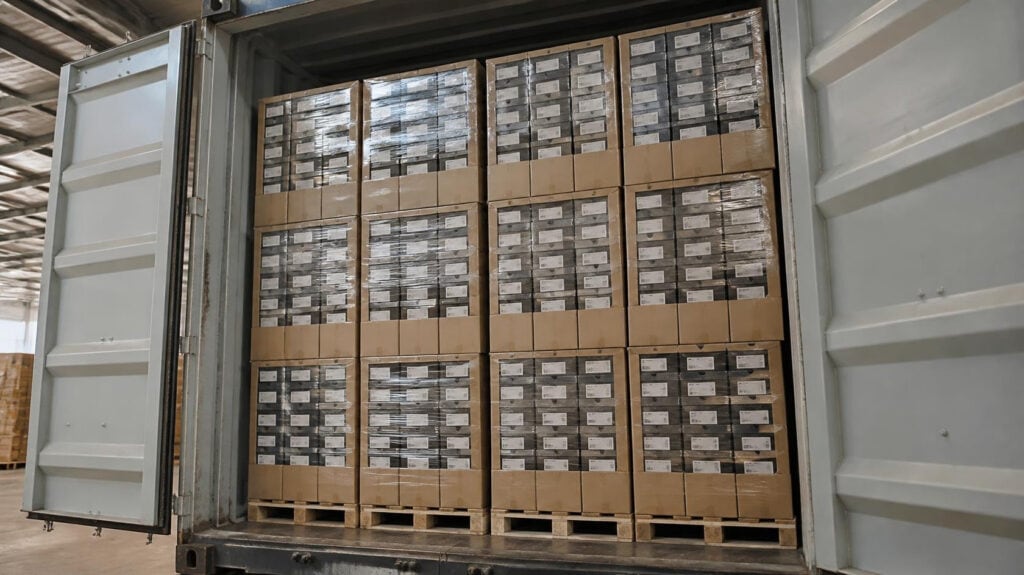
Even a small dimensional change can shift how many boxes fit per layer, so it pays to check box and carton sizing together — not one at a time.
Avoid Oversized Packaging Fees
Boxes larger than they need to be cost you on every front. They:
- Waste space in cartons, on pallets, and in containers
- Raise freight through higher DIM weight
- Use more board and filler than needed
The right-sized box removes that waste — less material, more efficient shipping, and less risk of the oversized-parcel surcharges some carriers apply to bulky packages.
How Wrong Shoe Box Sizes Increase Packaging Costs
Sizing errors cut both ways. Too small and too large each create their own problems — and each adds cost that compounds at scale.
When the Box Is Too Small
A tight box looks like it saves material, but the downstream costs are real:
- Shoe damage — crushing, creasing, and sole deformation in transit
- Poor presentation — shoes that are hard to remove or arrive misshapen
- Customer returns — damaged or awkwardly packed products drive refunds and replacements
When the Box Is Too Large
Oversizing is the more common — and often more expensive — mistake:
- Higher material cost — more board per unit across the whole run
- More filler — extra padding to stop shoes shifting
- Higher shipping fees — more DIM weight, lower packing density
For a brand shipping thousands of pairs a month, box dimensions aren’t a minor tweak. Even a modest size reduction can cut material spend, improve carton and container utilization, and lower freight — and those savings repeat on every shipment.
Packoi Expert Tip:
Before you lock a box size for a high-volume SKU, run a quick comparison of material cost, units per carton, and DIM weight across two or three candidate dimensions. The cheapest option is rarely the smallest — it’s the one that packs most efficiently into your cartons and containers.
Custom Shoe Box Dimensions: What Brands Should Consider
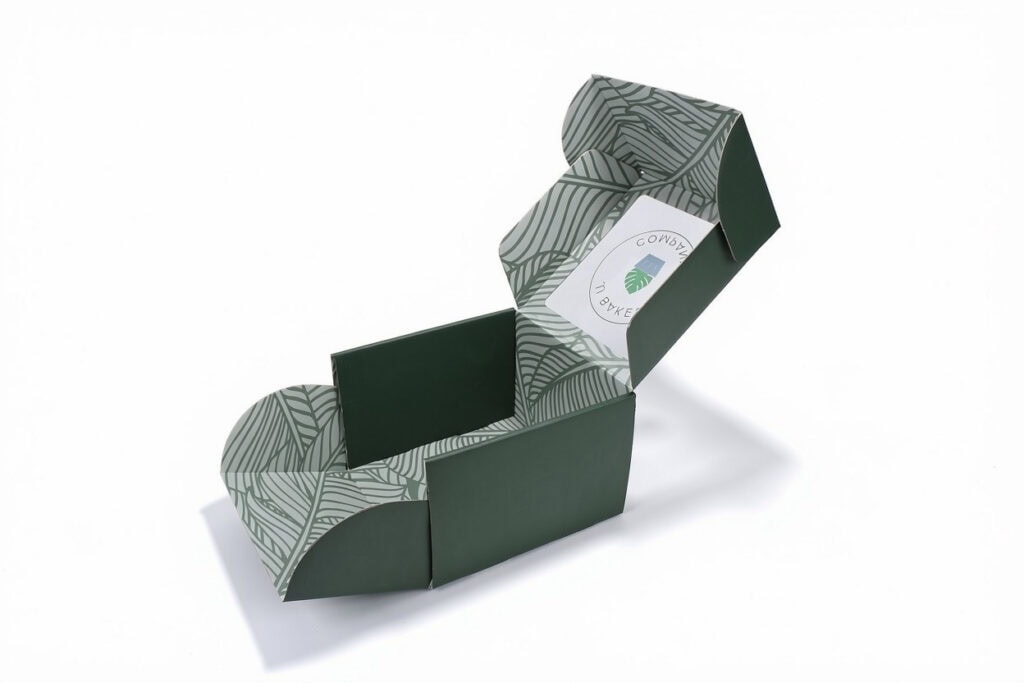
Standard sizes work well for many products, but growing footwear brands usually reach a point where custom makes more sense — to fit an unusual product, improve efficiency, or strengthen brand identity. When you make that move, a few decisions matter most.
Match the Box to Your Actual Product Line
Any custom box should start from your real product data, not a number off a chart. Build your dimensions around:
- Actual shoe measurements — taken from the largest size in each SKU group
- Packaging inserts — tissue, dust bags, forms, and any branded extras
- Protection level — how much clearance and padding the product genuinely needs
Get these three inputs right and the box fits, protects, and doesn’t waste space or material.
Balance Branding With Efficiency
Custom packaging is a chance to reinforce your brand through premium packaging — but it works best when design and logistics are planned together. A box can carry premium finishing and stay cheap to ship, if it’s engineered with both in mind.
52% of online shoppers prefer brands with impressive packaging.
Practical factors to weigh:
- Box style — two-piece lid-and-base boxes feel more premium, and luxury shoe boxes may also use rigid walls, magnetic closures, or drawer designs; folding cartons are lighter and ship flat, so they cost less
- Print and finishing — logos, colors, and coatings that match your brand without over-complicating production
- Shipping efficiency — dimensions that still pack cleanly into master cartons and containers
The best custom boxes deliver brand impact without giving up the packing density that keeps freight down.
Plan for Multiple Size Options
A single box size rarely fits a full range well. A box built for a men’s boot leaves a child’s shoe swimming; a box built for a compact sneaker won’t close over a tall boot.
Most brands settle on a small set of standardized sizes — usually two to four — that cover the range while keeping SKUs manageable. That balances good fit against the cost and simplicity of standardization.
Packoi Expert Tip:
When brands first move to custom packaging, the most frequent oversight is designing around a “typical” size instead of the largest size that has to fit. Confirming the maximum shoe dimensions in each group before we finalize the box prevents late-stage fit problems and costly redesigns.
Choosing the Right Shoe Box Material
Dimensions decide whether a shoe fits — packaging material decides whether the box protects it and represents your brand well. The right choice depends on how the box is used and how much protection and presentation you need.
Common options:
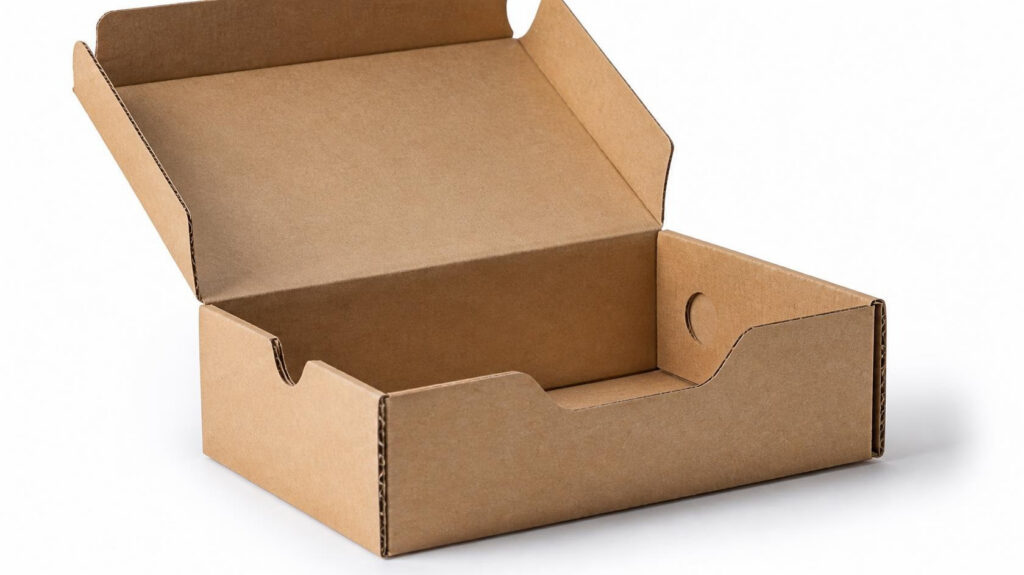
- Corrugated board — strong and protective, ideal for shipping and stacking. corrugated cardboard is the most common shipping material because its fluted structure absorbs impact and resists crushing, which makes it a solid fit for eCommerce and bulk transport.
- Rigid board — premium and structured, used for high-end presentation. It holds its shape firmly and feels luxurious, favored for dress shoes and designer footwear.
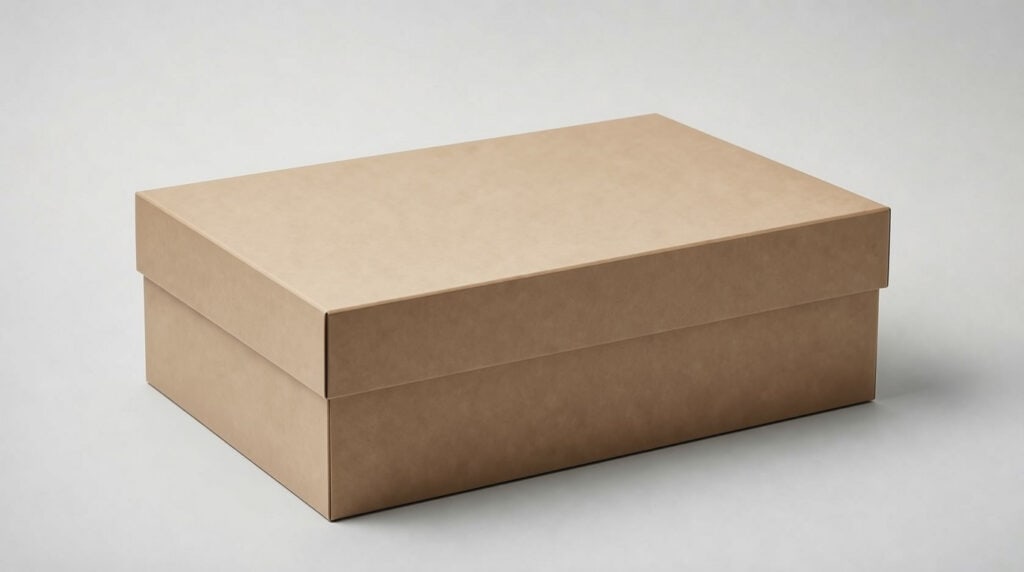
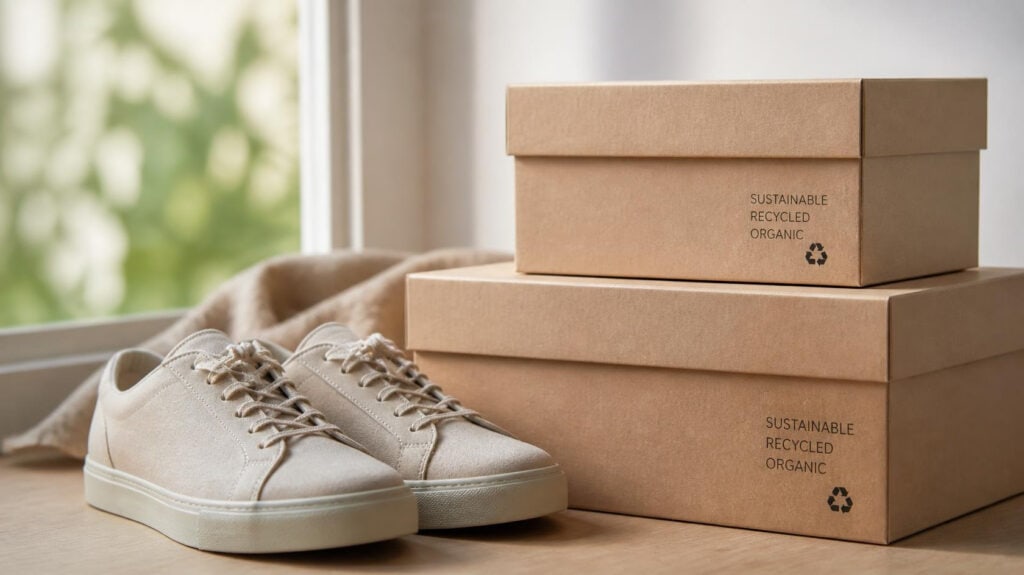
- Kraft / eco-friendly options — recyclable and sustainable, chosen by brands that prioritize environmental positioning and a natural, understated look. Casual shoes may be packed in lightweight Kraft boxes. This also matters for brands shipping into the EU, where plastic-reduction rules keep tightening.
Match the material to the box’s real job:
- Shipping durability — for parcels traveling long distances or shipping individually, prioritize protective, stackable board, and note that winter boots often need heavier-duty boxes for protection.
- Premium presentation — for retail and luxury products, prioritize rigid, cleanly finished materials.
- Sustainability goals — for eco-focused brands, prioritize recyclable, responsibly sourced materials.
Match material to purpose and the box performs where it counts — whether that’s surviving a long sea route or holding up a premium in-store display.
How Premium Brands Use Shoe Boxes to Build Brand Experience
For established footwear brands, the shoe box is more than protection — it’s part of the product. Right-sized, well-designed shoe packaging turns a simple container into a branding tool that shapes how customers perceive quality and how a shoe brand is remembered.
Premium brands treat the box as an extension of the shoe. You can see it in practice:
- Nike and Adidas use clean, consistent, right-sized packaging that reinforces a confident, recognizable identity across every product tier.
- Luxury footwear brands invest in structured rigid boxes and refined finishing that signal exclusivity the moment the customer sees the box.
The takeaway for growing brands: packaging and dimensions work together. A box that fits cleanly, uses the right material, and carries thoughtful branding lifts the whole unboxing experience — and with it, the perceived value of the shoes inside.
Well-planned dimensions are the foundation of that experience. Without the right size, even premium materials and print can’t deliver a clean, confident presentation.
Frequently Asked Questions About Custom Shoe Box
Q1:What is the standard shoe box size?
There’s no single standard, and standard shoe box sizes vary by category, but most adult shoe boxes run around 13–14 inches long, 8–9 inches wide, and 4–5 inches high. Boot boxes can start around 14 × 10 × 5 inches and scale larger depending on shaft height and structure, while some boots need larger boxes (around 18 × 12 × 6 inches), and kids’ shoes use smaller ones (around 10 × 7 × 4 inches). The right size depends on your specific shoe type, the largest size in your range, and any inserts.
Q2:How do I measure shoe box dimensions?
To measure a shoe box, place it on a flat surface and use a tape measure or other measuring tool to record Length × Width × Height. Length is the longest side, width is the shorter horizontal side, height is the vertical depth. Measure the inside dimensions to confirm the shoe fits, and for shipping use the lid closed and record the outside dimensions.
Q3:What’s the difference between inside and outside shoe box dimensions?
Inside dimensions decide whether the product fits; external dimensions decide how the box ships, stacks, and stores. Outside dimensions are always larger because board thickness adds to every wall. Always specify which one you mean when requesting a quote.
Q4:How much extra space should a shoe box have?
Allow roughly 0.5–1 inch of clearance beyond the shoe for tissue, dust bags, and inserts. Sneakers need less tolerance, leather shoes need more protective space, and boots need extra height.
Q5:Does shoe box size affect shipping cost?
Yes. Carriers calculate dimensional (DIM) weight from a package’s volume, so oversized boxes cost more to ship even when they’re light. Right-sizing your shipping shoe box lowers DIM weight, improves carton and container packing, and cuts material use.
Q6:Can I get custom shoe box dimensions?
Yes. Custom boxes are built around your actual shoe measurements, inserts, and protection needs. Most brands use a small set of standardized custom sizes to cover their range while keeping SKUs and costs manageable.
Conclusion: Getting Shoe Box Dimensions Right
Shoe box dimensions affect far more than fit — they shape product protection, shipping cost, and the unboxing experience. The smartest approach for most brands is a small set of standardized sizes built around the largest shoe in each SKU group: sized for fit, engineered for efficient shipping, and finished to reflect your brand.
Start from your real product measurements, not a generic chart, and you’ll get boxes that protect the product and keep freight under control.
Get Custom Shoe Boxes Built Around Your Product
With over 12 years of paper packaging export experience serving footwear and DTC brands worldwide, Packoi handles the full process — structural design, material selection, printing, finishing, and pre-production samples — and engineers every box around your actual product.
Send us your shoe dimensions, insert requirements, and priorities — fit, cost, or presentation — and our team will confirm the right inside and outside dimensions and provide a sample before you commit to a full run.
Ready to lock in the right size? contact us today for a free quote or request a pre-production sample.