
Get it wrong, and you end up with boxes that don’t fit, crush under stacking, or waste money on every pallet.
In this guide, you’ll get the exact standard dimensions, the difference between letter and legal sizes, the main box types, and a simple way to choose the right size and strength — whether you’re buying one box or ten thousand.
What Is a Bankers Box?
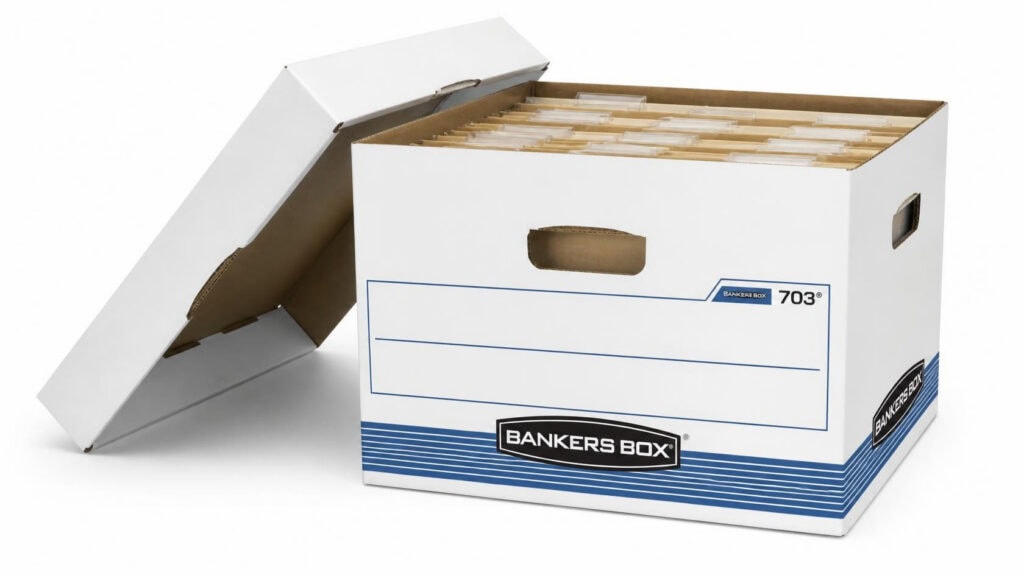
A bankers box is a corrugated cardboard storage box designed to hold and transport documents — typically letter or legal-size files, folders, and long-term records.
The name comes from banking and legal offices, where teams needed a standard, stackable box to archive paperwork without buying custom containers every time. The design stuck because it’s cheap, foldable, and easy to label.
Today you’ll find them almost everywhere paper piles up: law firms, accounting offices, schools, hospitals, and warehouse record rooms. Common design features include lift off lids and built-in hand holes for carrying.
The key thing to remember: “bankers box” is a category that includes different sizes, not one fixed size. That’s exactly why buyers get confused — so let’s look at the actual numbers next.
Standard Bankers Box Dimensions
Here’s the part most people came for: the real measurements.
Bankers boxes are usually described by their internal dimensions (the usable space for files) because that’s what determines what actually fits. Below is a table of the most common standard sizes you’ll see from suppliers, with measurements shown in inches.
Type | Internal Dimensions (L × W × H) | Best For |
Letter Size | 12" × 10" × 15" (305 × 254 × 381 mm) | Standard office files, A4/letter folders |
Legal Size | 15" × 10" × 12" (381 × 254 × 305 mm) | Legal documents, wider folders |
Letter/Legal Combo | 15" × 12" × 10" (381 × 305 × 254 mm) | Mixed file sizes in one box |
Medium/General Storage | 16" × 12" × 12" (406 × 305 × 305 mm) | General supplies, mixed contents |
Heavy-Duty Archive | 15" × 12" × 10" (381 × 305 × 254 mm) | Long-term storage, heavier loads |
Most standard bankers boxes are about 10–12 inches wide, while medium-size bankers boxes vary by supplier and commonly fall within the 16–18 inch length range.
A quick note on how to read these: length is the front-to-back file depth, width is side-to-side, and height is how tall the box stands. When folders sit upright inside, the internal length and height matter most.
One practical tip from the buying side — always confirm whether a supplier is quoting internal or external dimensions. External measurements include the board thickness, so a “12-inch” external box has slightly less usable space inside. On a single box that’s trivial. Across a container of 2,000 boxes, that small difference decides whether your files fit and whether the boxes stack cleanly on a pallet. A standard file box in this size range typically holds around 2,000–2,500 sheets of paper, depending on paper thickness and folder usage.
If you’re storing standard letter/A4 paperwork, the letter-size box is designed to accommodate letter size documents for most day-to-day needs. If your files run wider — legal documents, oversized folders — the legal-size box saves you from bending paper to make it fit.
Different Types of Bankers Boxes and Their Dimensions
Not all bankers boxes are built the same. The size might look similar on paper, but the box type changes how much weight it holds, how well it stacks, and how long it lasts. Here are the four types you’ll deal with most.
Standard Bankers Box
This is the everyday workhorse — usually letter or legal size, single-wall corrugated, with a lift-off lid and hand holes.
It’s built for active file and document storage: boxes you open, refile, and move around the office. Internal dimensions for letter-size bankers boxes are commonly around 12″ × 10″ × 15″, although dimensions can vary slightly between manufacturers. It’s the cheapest option and perfectly fine for light to moderate use. Standard bankers boxes are more suitable for documents than typical moving boxes because they’re sized for files and routine office handling.
Just don’t expect it to survive being stacked five-high in a humid warehouse for two years. That’s not what it’s designed for.
Legal Bankers Box
Same basic construction, but sized to accommodate legal documents and oversized folders. A typical legal-size bankers box is around 15 inches wide, with dimensions varying slightly by manufacturer and whether internal or external measurements are used.
Law firms and accounting offices lean on these because forcing legal-size paper into a letter box means folded corners and damaged records. If your paperwork runs wider than standard A4, this is the box that saves you headaches.
Heavy-Duty Bankers Box
This is where material matters more than dimensions, because sizes can vary across manufacturers even in heavy-duty formats. Heavy-duty boxes use thicker board — often double-wall corrugated — to carry heavier loads and hold their shape under stacking pressure. Some heavy-duty options use plastic instead of cardboard. One example is a heavy-duty plastic bankers box measuring 17.38″ × 14.19″ × 10.63″.
They’re built for long-term archiving: the boxes that sit in storage for years, stacked on pallets or shelving. For records storage, file-oriented bankers boxes can deliver roughly 15–20% more storage density per square foot than standard plastic totes. If you’re shipping records overseas or storing them somewhere with humidity, this is the grade to ask for.
A candid tip from the supply side: buyers often try to save money by ordering standard boxes for archive use, then discover after a few months that the bottoms sag or the corners crush. The board grade is where durability lives — not the dimensions. Heavy-duty boxes are also more sturdy for long-term stacking, which is why this matters.
Drawer-Style Bankers Box

Instead of a lift-off lid, these open like a drawer, so you can access files without unstacking the boxes above them.
They cost a bit more, but for offices that pull files regularly, the time saved and improved functionality for frequent file retrieval are worth it. Dimensions are similar to standard letter/legal boxes — the difference is entirely in the access design.
Letter vs Legal Size Bankers Boxes: Which One Do You Need?
This is the single most common question buyers ask, so let’s settle it clearly.
The difference comes down to the paper you’re storing:
- Letter-size boxes fit standard Letter documents (8.5″ × 11″) and are commonly used for everyday office files. If you need to store A4 folders, confirm the internal dimensions before ordering in bulk. Internal dimensions are roughly 12″ × 10″ × 15″. This covers most everyday office documents.
- Legal size fits legal paper (8.5″ × 14″) and wider folders. These boxes provide extra length and width compared with letter-size boxes, allowing longer documents to be stored flat without folding.
Here’s the simple rule:
If your documents fold, bend, or stick out the top of a letter box, you need legal size.
For most general offices, DTC businesses, and schools, letter-size boxes handle the majority of paperwork. Legal-size boxes matter most for law firms, real estate offices, and anyone dealing with contracts, deeds, or oversized records.
One more practical point for bulk buyers: if your team stores both letter and legal files, mixing two box sizes complicates stacking and shelving. In that case, a letter/legal combo box (often around 15″ × 12″ × 10″, depending on the manufacturer) lets you standardize on one footprint so it can accommodate both formats more cleanly for organizing and stacking. When you’re ordering thousands of boxes, one consistent size is easier to store, ship, and reorder.
How to Choose the Right Bankers Box Size

Picking a size isn’t just about what fits your files today — it’s about how you store, stack, and move the boxes over time. Here’s how I’d walk a buyer through it.
Start With What You’re Storing
Measure your actual documents and folders first. Standard letter/A4 files? A letter-size box works. Legal documents or wider folders? Go legal size. Mixed contents? A combo box keeps things simple.
Don’t guess based on the box name — check the internal dimensions against your real paperwork.
Think About Weight, Not Just Volume
A box that’s the right size but too weak is a false economy. Packed files are heavy — a fully loaded letter box often weighs around 10–15 kg, with heavier loads reaching approximately 20 kg depending on the contents. If you’re stacking boxes or storing them long-term, the board strength matters more than an extra inch of space.
Under-buying on strength is the mistake I see most often. Boxes look fine when they arrive, then the bottom ones crush after a few months under load.
Match the Size to Your Shelving and Pallets
This is where bulk buyers lose money without realizing it. If your box dimensions don’t divide cleanly into your pallet footprint or shelving units depth, you waste space on every layer, and a more compact footprint can reduce wasted space on shelves and pallets.
Before a large order, check how your chosen size stacks on a standard pallet. A slightly different box dimension can mean the difference between fitting neatly and leaving dead space — which you pay to ship.
Consider How You’ll Access the Files
If files stay archived and untouched, a standard lift-off lid is fine. If your team pulls files often, drawer-style boxes save real time, and lid style is one of the key features that affects access. Access frequency should shape the box type as much as the size does.
Quick guide by buyer type:
- Small offices / startups: Standard letter-size boxes cover most needs, including home-office or personal record storage. Order a single size to keep things simple.
- Law firms / records-heavy businesses: Legal or combo sizes, and consider heavy-duty grade for long-term storage.
- Bulk buyers / warehouse storage: Standardize on one footprint, prioritize board strength, and confirm pallet fit before ordering.
What Materials Are Bankers Boxes Made From?

The size gets the attention, but the material decides whether the box actually survives. Here’s what you’re really choosing between.
Corrugated Cardboard: Single-Wall vs Double-Wall
Almost all bankers boxes are made from corrugated board — that’s the fluted paper layer sandwiched between flat liners that gives the box its strength.
- Single-wall corrugated is standard for everyday office boxes. It’s lighter, cheaper, and fine for active file storage.
- Double-wall corrugated adds a second fluted layer for extra strength. This is what you want for heavy loads, high stacking, or long-term archiving.
If you remember one thing: single-wall for daily use, double-wall for heavy or long-term storage.
Board Strength (ECT and Bursting Strength)
When ordering in bulk, suppliers describe board strength using ratings like ECT (Edge Crush Test). In plain terms, ECT measures how much stacking pressure the box walls can take before crushing.
You don’t need to memorize the numbers — you just need to tell your supplier the real conditions: how heavy the contents are, how high you’ll stack them, and whether they’ll sit in storage for months or years. A good supplier matches the board grade to that. If a supplier quotes only price and dimensions but never asks about your load or stacking, that’s a warning sign.
Recycled vs Virgin Paper
Most bankers boxes use a high percentage of recycled content, which is both cost-effective and better for buyers who need to meet sustainability or eco-compliance requirements. For markets like the EU, where eco-friendly packaging expectations are rising, recycled corrugated is usually the sensible default.
Virgin paper gives a cleaner surface and slightly higher strength, but for storage boxes, recycled board is almost always the practical choice.
A Note on Sea Transport
One point specifically for overseas buyers: humidity during long sea freight is the quiet killer of corrugated boxes. Cardboard absorbs moisture, and moisture weakens the board — so boxes that tested fine at the factory can arrive soft.
If your order is shipping by sea and will be stored before use, ask your supplier about moisture-resistant liners or a higher board grade. It’s a small spec decision at order time that helps protect documents during sea transport and storage instead of leaving you with a whole container of weakened boxes on arrival.
Custom Bankers Box Options
Sometimes the different sizes just don’t fit your needs — and that’s when a custom order makes more sense than forcing an off-the-shelf box to work.
You’d typically consider custom boxes when:
- Your documents or contents are a non-standard size that wastes space in stock boxes.
- You need a specific board strength for heavy loads, high stacking, or long sea freight.
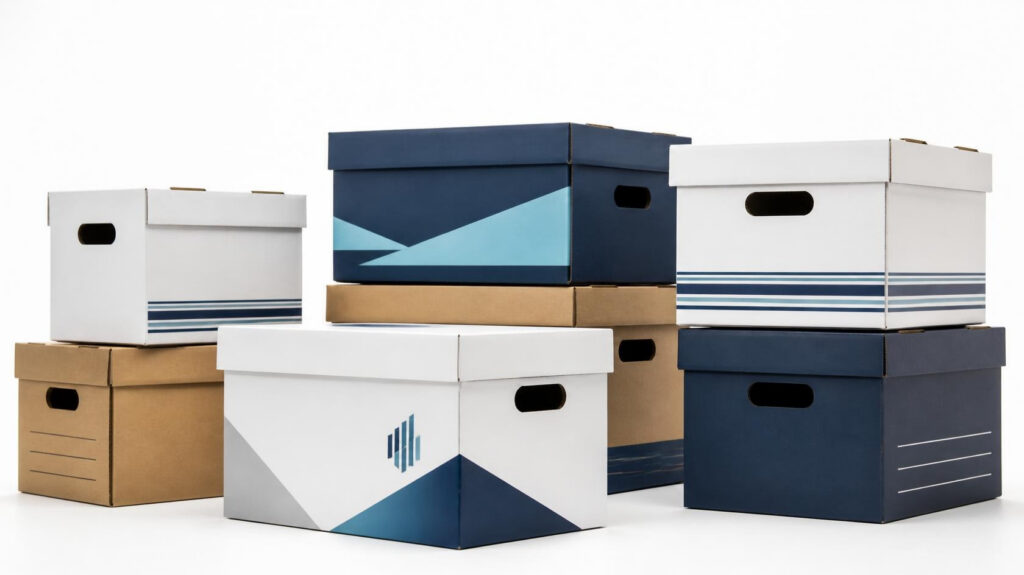
- You want branded printing — your logo, color, or labeling — for a more professional look or stronger brand presentation.
- You’re ordering at volume, where even small dimension changes improve pallet efficiency and cut freight cost.
Here’s what you can usually customize:
- Dimensions — sized to your exact contents or shelving.
- Board grade — single-wall, double-wall, or a specific ECT rating.
- Print and branding — one-color logo up to full-color print for presentation and identification.
- Lid style — lift-off, drawer, or attached.
- Finish — moisture-resistant coating or liners for humid environments or sea transport.
A realistic note on ordering custom: some suppliers or manufacturers offer low MOQ custom runs, but custom boxes usually come with a minimum order quantity (MOQ), because tooling and setup only make sense at volume. If you’re buying a few dozen boxes, stock sizes are far more economical. But if you’re ordering thousands — or reordering the same box regularly — custom sizing often pays for itself in better stacking, lower shipping cost, and less wasted product.
When you request a custom quote, give your supplier three things upfront: the internal dimensions you need, the weight and type of contents, and your storage or shipping conditions. That’s enough for a supplier to recommend the right board grade and give you an accurate price without a lot of back-and-forth, though custom dimensions and features can have small variations by manufacturer.
Frequently Asked Questions About Bankers Box Dimensions
Q1:What are the standard dimensions of a bankers box?
The most common letter-size bankers box measures about 12″ × 10″ × 15″ (305 × 254 × 381 mm) internally. Legal-size boxes are wider, around 15″ × 10″ × 12″. Always confirm whether a supplier quotes internal or external dimensions.
Q2:What’s the difference between letter and legal bankers boxes?
Letter boxes fit standard letter/A4 paper, while legal boxes are wider to hold legal-size documents (8.5″ × 14″) without folding. If your files bend or stick out of a letter box, you need legal size.
Q3:How much weight can a bankers box hold?
A standard single-wall box comfortably holds a full load of files — often 15–20 kg. For heavier loads or high stacking, choose a double-wall or heavy-duty grade rated for the stacking pressure you expect.
Q4:Are bankers boxes stackable?
Yes, most are designed to stack. But stacking safely depends on board strength, not just size. For tall stacks or long-term storage, use a higher board grade so the bottom boxes don’t crush.
Q5:Can I order custom-sized bankers boxes?
Yes. Custom dimensions, board strength, printing, and finishes are all available, usually above a minimum order quantity. Custom orders make the most sense for bulk buyers or non-standard contents.
Choosing the Right Bankers Box for Your Business
Choosing the right bankers box comes down to three things: the size that fits your documents, the board strength that matches your load, and a footprint that stacks and ships efficiently.
For everyday office files, a standard letter-size box works. For legal documents, go legal size. For archiving, heavy loads, or overseas shipping, don’t cut corners on board grade — that’s where most sizing mistakes turn into damaged files.
Before you order in bulk, confirm three details: your internal dimensions, contents weight, and storage or shipping conditions. Get those right and you avoid the two most common regrets — boxes that don’t fit, and boxes that don’t last.
Get Help Choosing the Right Bankers Box
Send us your dimensions and contents details, and Packoi will recommend the right size or a custom spec — with a fast quote for orders shipped nationwide. Contact us or request a quote today.