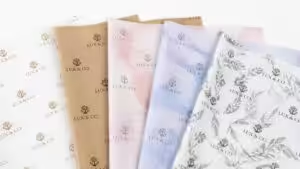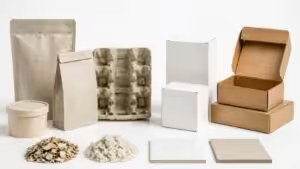
As brands increasingly seek eco-friendlier solutions, soy ink packaging has garnered significant attention. But why is it considered a greener alternative, and is it truly 100% toxin-free?
This article delves into the manufacturing process of soy ink, examining its unique advantages and limitations, and exploring its diverse applications in modern packaging. Gain a comprehensive understanding of this sustainable printing choice, from its production to its practical use.
What Is Soy Ink Packaging?
Packaging that utilizes soy ink for printing is referred to as soy ink packaging.
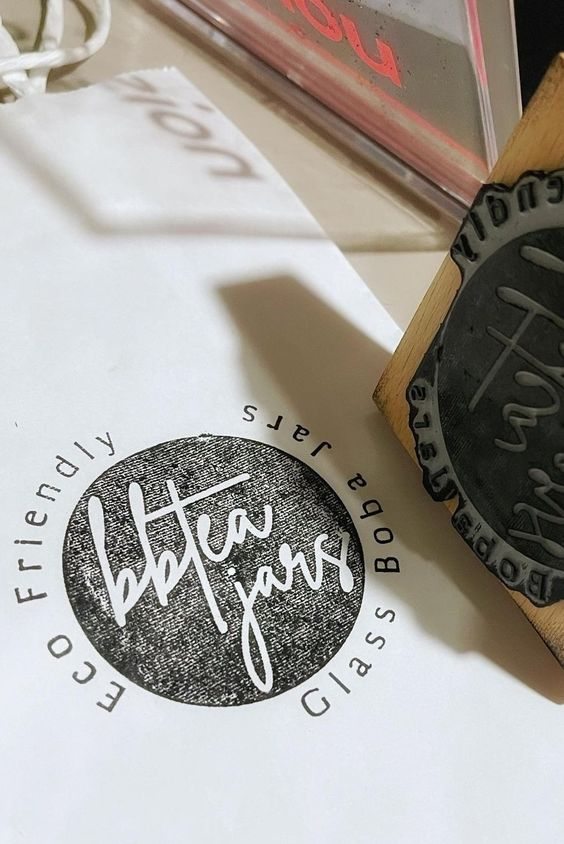
Now, what is soy ink?
Introduced to the market as a result of the petroleum crisis in the 1970s by a newspaper company, soy ink is now playing a crucial role in making the printing industry more environmentally friendly.
In the manufacturing process, soy oil is used as a substitute for petroleum-based ink. The soy-based inks are four times more biodegradable than petroleum-based inks.
Volatile Organic Compounds (VOCs) emitted by petroleum-based inks are less than 20% in soy ink when printing. Additionally, soy-based ink minimizes hazardous air pollution (HAC) emissions. You can reduce the environmental impact of your printing press by replacing traditional petroleum-based inks with soy-based inks.
6 Major Benefits of Using Soy Ink Packaging
Here are the six main benefits that you get by replacing petroleum-based ink with soy-based ink.
1. Renewable Resource
Soy-based ink is made from soybeans, a renewable resource that can be grown indefinitely. Soybeans provide a never-ending supply of plant feedstock, which is then used as fuel and for many other products.
This stands in stark contrast to petroleum-based inks, which rely on finite fossil fuels – a resource that is depleting and contributes to environmental instability through extraction and processing.
By choosing soy, brands actively reduce their dependence on non-renewable sources, securing a more sustainable supply chain for packaging.
2. Heat Resistant
The soy ink on your packaging will have more thermal resistance than petroleum-based ink because soy ink has a lower boiling point. This lower boiling point for the solvent component means soy ink dries more thoroughly and quickly, leaving a more robust and stable pigment film that resists heat degradation better.
In contrast, residual solvents in some petroleum inks can make them more susceptible to smudging, softening, or color alteration when exposed to moderate heat during packaging processes like shrink-wrapping or heat-sealing, compromising print integrity.
3. Brighter Colors
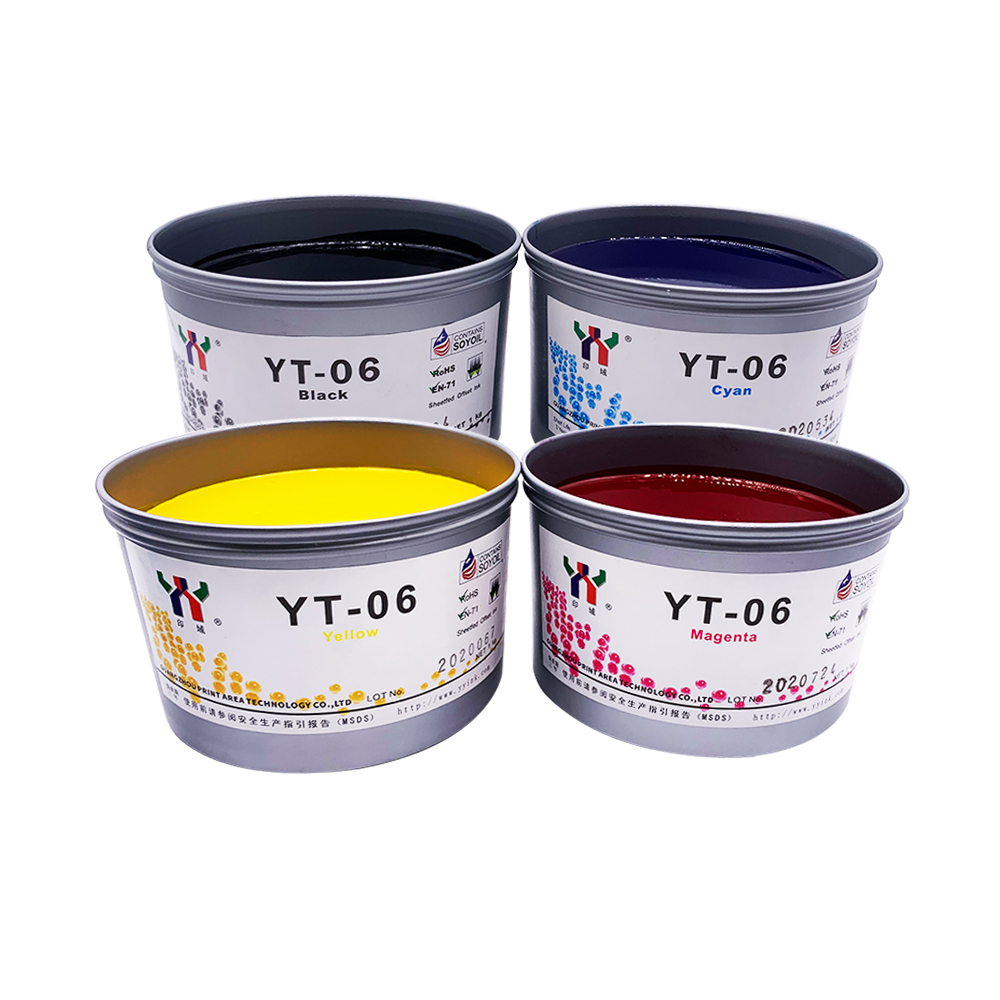
If you print with soy-based ink, the printed picture will have brighter colors and more precise definitions. This is because the lucid nature of soy-based ink allows the ink pigments to be the brightest.
Petroleum-based inks often have a slight yellowish or brownish tint due to their oil base, which can subtly dull or obscure the true vibrancy of the pigments.
Soy ink’s inherent clarity acts as a purer medium, allowing the pigments to fully express their intended color and sharpness, leading to a superior visual impact on your packaging compared to the potentially muted tones of petroleum inks.
4. Economic
The use of soy inks will prove to be more economical than metallic inks, as they produce clear and bright images effortlessly. Soy inks will get the work done with minimum resources.
While the original statement compares to metallic inks, soy inks also offer economic advantages over standard petroleum-based inks for several reasons. Their superior pigment release often means less ink is required to achieve the same color density and brilliance, directly reducing ink consumption and material costs.
Furthermore, soy inks are gentler on printing press rollers, reducing wear and tear and extending the lifespan of equipment, which translates to lower maintenance and replacement costs compared to the more abrasive characteristics of some petroleum inks.

5. Stability
Using soy-based ink for your printing saves time, as you do not have to adjust the ink at every step of the process. This is because soy inks are much more stable than petroleum inks.
Petroleum inks can be more prone to viscosity changes, “skinning” (drying on the press), or inconsistent flow during long print runs, demanding frequent adjustments from operators. This instability leads to increased press downtime, wasted materials due to inconsistent quality, and a slower production cycle.
Soy ink’s inherent stability significantly reduces the need for these mid-run corrections, ensuring smoother, faster, and more consistent print quality from start to finish compared to its petroleum counterparts.
6. Eco-Friendly
Although soy ink is not 100% eco-friendly (as declared by the Environmental Conservation Board), it is still better than petro-based inks because it releases fewer amounts of VOCs into the air.
Moreover, soybean plants absorb carbon from the environment during growth, so shifting to soy ink reduces the carbon footprint. This benefit highlights a critical environmental distinction: petroleum inks typically contain higher levels of harmful Volatile Organic Compounds (VOCs), which contribute to air pollution and health concerns.
Furthermore, petroleum itself is a fossil fuel whose extraction and combustion release vast amounts of stored carbon into the atmosphere, directly contributing to climate change.
By contrast, soy ink’s lower VOC emissions and the carbon-sequestering properties of soybean plants offer a tangible reduction in environmental impact and a step towards mitigating climate change, making it a distinctly greener choice for packaging.

4 Limitations and Disadvantages of Soy Ink in Packaging
Soy ink offers environmental benefits and bright colors. Yet, understanding its limitations is key for choosing printing materials.
1. Longer Drying Times and Production Delays
Soy ink dries slowly. This is a primary concern.
Traditional inks dry in minutes. Soy ink often needs hours, or even overnight, to dry. This slow drying time delays production schedules. It especially impacts large or urgent print jobs. Printers may need special drying equipment or more racks. This raises costs. It also increases the risk of ink smudging or transfer.
Thus, soy ink is less ideal for projects needing quick processing.
2. Adhesion Challenges on Non-Absorbent Substrates
Soy ink sticks well to paper. But it struggles on non-absorbent materials.
These include plastics, foils, or coated packaging. This limits its use for tough packaging needs. Such jobs require durable print that resists scuffs, water, or chemicals. To make it stick, printers often need extra varnishes or coatings. These additions can negate its eco-benefits. They also add cost and complexity to adhesion.
3. Higher Initial Cost Considerations
Soy ink offers long-term benefits, like easier recycling.
However, its initial cost can be higher than regular inks. This is especially true for small orders or special types. Businesses must compare eco-benefits against upfront investment. The immediate budget impact often decides.
4. Compatibility with Advanced Printing Processes
Soy ink compatibility is improving. Still, some high-speed printers or specialized machines may struggle with it. They might need specific adjustments.
Or they may not work as well as with petroleum inks. This makes full integration harder for industrial printers. Careful testing is needed. Custom ink types might also be necessary to ensure compatibility and avoid problems at high speeds.
Practical Guide to Selecting Soy Ink for Specific Printing Needs
Choosing the right soy ink is not a one-size-fits-all decision; it requires careful consideration of your specific printing process, substrate materials, and desired quality to achieve optimal results and cost efficiency.
Considerations for Printing Process
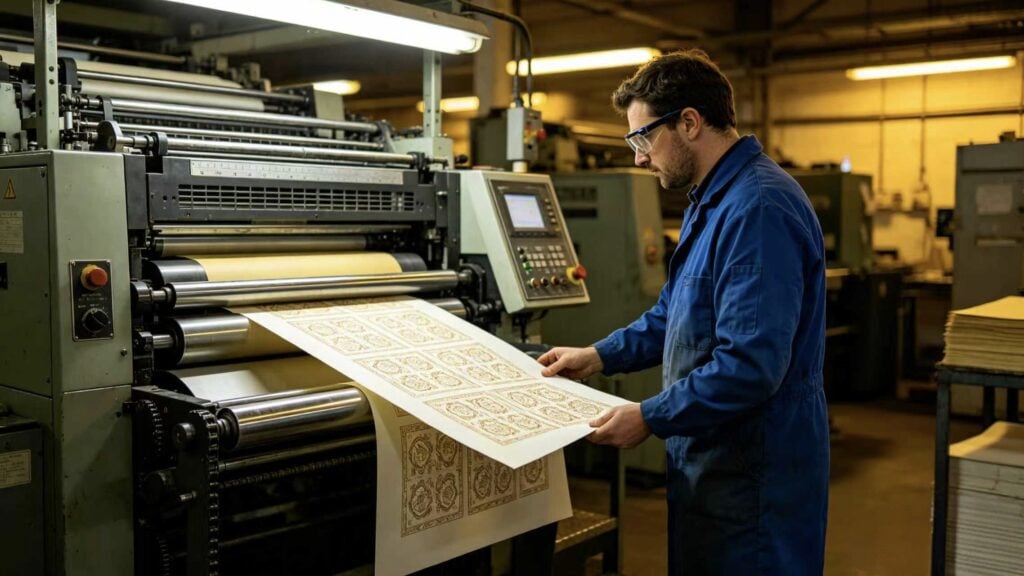
For offset printing, soy ink is incredibly mature and widely adopted. Its inherent stability and excellent ink transfer properties make it an ideal choice for paper and cardboard packaging. For high-color-fidelity applications like brochures, books, and carton boxes, standard offset soy inks can easily achieve vibrant colors and sharp details.
When it comes to flexography, often used for flexible packaging such as food bags and film labels, soy inks require specialized formulations to ensure superior adhesion and rapid drying speed on non-absorbent substrates. It is crucial to confirm with your ink supplier that they offer soy inks specifically designed for flexo, providing good flexibility and scratch resistance.
While less common, soy-based inks are also developing for other processes like gravure and inkjet. For these niche applications, more customized ink solutions may be necessary, and direct communication with your supplier about your specific equipment and requirements is essential.
Considerations for Substrate Materials
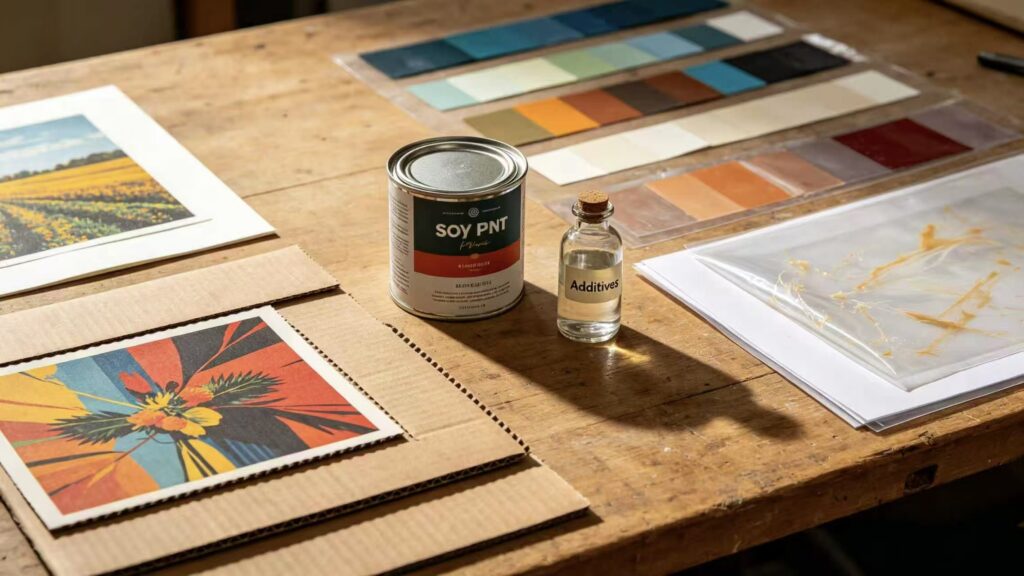
Soy ink performs exceptionally well on absorbent substrates like paper, cardboard, and corrugated board. Its excellent penetration allows the ink to adhere and dry effectively while maintaining bright colors, making standard soy inks suitable for most needs with these materials.
However, for non-absorbent substrates such as plastic films (PP, PE, PET, BOPP) and coated papers, drying time and adhesion become critical challenges. Soy inks for these materials often require the addition of special drying agents or resin components to overcome these hurdles.
When selecting, you must specify the exact type of substrate, ensuring the chosen soy ink formulation provides sufficient adhesion and rub resistance to prevent issues during subsequent processing or transit.
Quality and Performance Expectations
If your packaging design demands extremely high color fidelity, the “lucid nature” of soy ink allows pigments to express purer colors. Ensure that the selected soy ink is compatible with your color management system to achieve the desired color reproduction.
For packaging that will endure handling, friction, or specific environmental conditions, you might need to consider applying varnish or lamination after printing with soy ink to enhance its surface protection. Some high-performance soy ink formulations also inherently improve durability.
High-speed printing presses demand rapid ink drying. For non-absorbent substrates, even soy inks might necessitate supplementary drying systems (such as IR or UV assistance) to accelerate curing and prevent set-off or smudging. Always confirm the ink’s actual drying performance at your specific press speed.
For sensitive product packaging like food and pharmaceuticals, selecting low-migration soy inks that comply with food contact regulations (e.g., FDA, EU) is paramount to ensure ink components do not transfer to the product, thereby safeguarding consumer safety.
Other Important Considerations
If your brand is committed to an eco-friendly image, opting for soy inks with environmental certifications such as USDA BioPreferred or Green Seal can significantly enhance your brand’s sustainability value.
Additionally, soy ink’s excellent de-inking properties make it a preferred choice in paper recycling processes, reducing the complexity and cost of recycling. Verify whether the selected ink supports your packaging’s overall recyclability strategy.
In summary, we strongly advise you to engage in thorough discussions with your ink supplier or printing experts before making a final decision. They can provide the most professional advice and facilitate sample testing tailored to your specific printing process, substrate materials, quality expectations, and any unique regulatory requirements, ensuring the chosen soy ink perfectly aligns with your packaging needs.
Myths about Soy Ink
Here are some myths related to soy-based ink that you might still believe to this date.
Soy-Based Ink is Purely Made Up of Soy
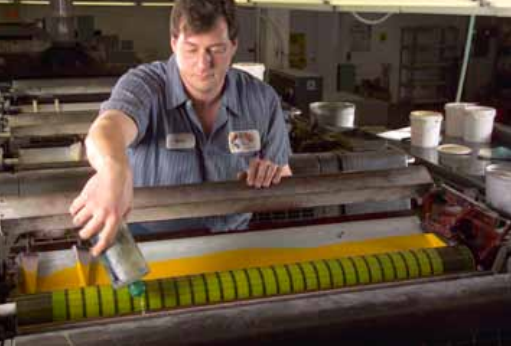
Soy oil contributes only 20% to the mass of soy ink. Here, the author refutes a common misconception about how soy ink is made. The other components that contribute to the mass of soy ink are resins, pigments, waxes, solvents, reducers, additives, driers, and film formers, which are toxic substances.
Soy Ink is 100% Environmentally Friendly
Soy and vegetable inks are a better and safer alternative to petro-based inks, but they are not entirely environmentally friendly due to the presence of some harmful additives. EPA does not label soy inks as “non-VOC.”
Additionally, the equipment used for soybean processing relies on diesel, petroleum, and electricity, which results in environmental pollution. Even if all the components are made from organic materials, such as organic resins and waxes, we can only mitigate the negative impact they typically have on the environment.
FAQ
Can You Place Soy Inks in Direct Contact with Edible Items?
The answer is no! Although soy inks are environmentally friendly in some ways, they are not 100% free from toxins. Some soy inks contain petroleum-based substances to allow the ink to dry faster, which can be toxic to the human body. However, the printed cards found within the cereal boxes are made from pure soy ink and are FDA-approved.
What specific certifications or labels should I look for to verify soy ink’s environmental claims?
To verify soy ink’s environmental claims, look for labels like the SoySeal (administered by the American Soybean Association), which indicates the ink contains a significant percentage of soy oil. Other relevant certifications might include USDA Certified Biobased Product labels, which verify the renewable content of a product. These certifications provide independent assurance of the ink’s sustainable attributes.
What are the safety considerations for using soy ink packaging with non-food items, such as cosmetics, toys, or medical products?
Beyond direct food contact, soy ink is generally considered safer for handling due to its low VOC content and non-toxic nature compared to petroleum-based inks. This makes it a preferred choice for packaging items like cosmetics, children’s toys, or personal care products where consumers might have prolonged skin contact or concerns about chemical transfer. However, specific regulatory compliance for medical devices or highly sensitive products should always be confirmed with the ink manufacturer and packaging provider.
How can Packoi help my brand effectively integrate soy ink into complex custom packaging designs?
Packoi specializes in guiding brands through the selection of appropriate sustainable materials and ink technologies like soy ink for complex packaging. We assist in choosing the right substrates that pair well with soy ink formulations, ensuring your design vision is realized while maintaining environmental integrity. Our expertise helps navigate compatibility, durability, and end-of-life considerations for your unique custom packaging needs.
Why Choose Packoi for Your Packaging Needs?
Looking for a sustainable packaging manufacturer to match the theme of your product?
You landed on the right page. At Packoi, we understand the importance of ecosystem perseverance. We use eco-friendly inks for your package printing, which have minimal environmental impact. With our vast range of custom packaging and printing solutions, our team will bring your design to life exactly as you envision it, making your experience with us one to remember.
We will stand by your side every step of the way throughout the manufacturing process. Contact us now for an immaculate brand packaging manufacturing experience.