
This guide shows you how to fix it. You’ll learn how to measure a shipping carton correctly, compare common box dimensions, understand how size affects freight costs, and decide when standard or custom packaging makes more sense.
Why Shipping Box Size Matters
Most businesses spend all their time thinking about the product and barely think about the box. But the box you pick decides a lot: whether your product arrives safe, how much you pay to ship it, how fast your team packs it, and how much you throw away.
So don’t just grab the closest box on the shelf. Choose it based on your product’s size, weight, how fragile it is, how you’re shipping it, and what your carrier charges for. A few extra minutes here saves you money all the way down the line.
It Keeps Your Product Safe
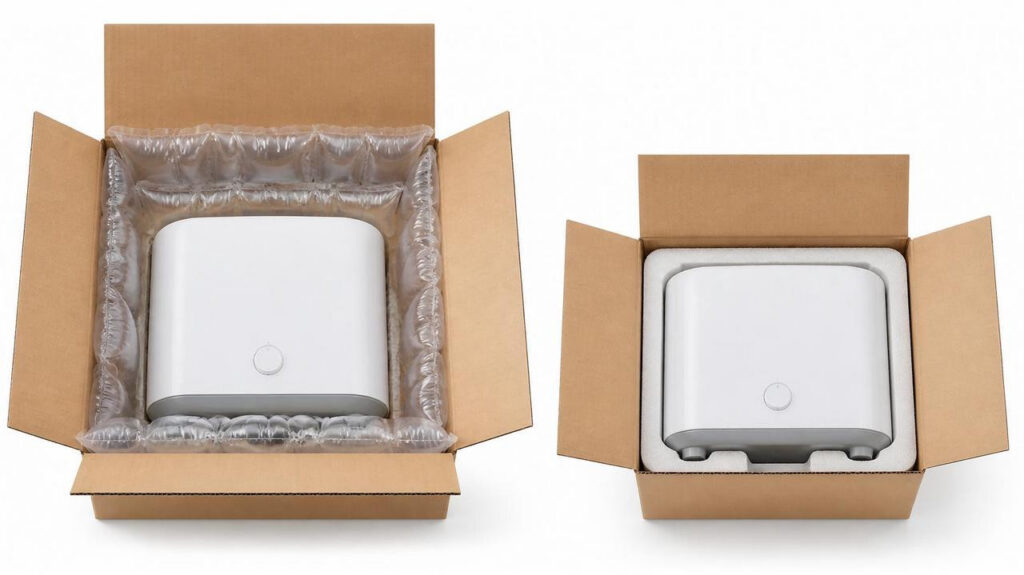
You might think a stronger box means better protection. It doesn’t. The right size does.
Too big, and your product slides around inside—even after you’ve stuffed it with foam, air pillows, or paper. Too small, and there’s no room to cushion it, so fragile things like electronics, glassware, or cosmetics get crushed. The best box leaves just enough space to protect the product, and nothing more.

It Lowers What You Pay to Ship
Carriers like UPS and FedEx don’t just charge by weight anymore. They also charge for the space your box takes up—this is called Dimensional (DIM) Weight. So a big box holding a light product can cost you a lot more than you’d expect.
Ship the same 2-pound item in two different boxes, and the bigger one can cost far more. Pick the right size, and you shrink that DIM weight and skip the extra carrier fees.

It Speeds Up Your Warehouse
Box size shapes your day-to-day work too. Stock too many sizes, and your inventory gets messy and eats up storage space. Default to oversized boxes, and your team wastes time adding filler and taping everything down.
The fix is simple: keep a small set of sizes that fit most of what you sell, and save custom boxes for the odd or high-volume items. Your team packs faster, picks more accurately, and you spend less on labor.
It Cuts Down on Waste
Right-sizing is the easiest way to waste less without putting your product at risk. A smaller box uses less cardboard, less filler, and less space on the truck. That gives you:
- Less cardboard and filler to buy
- More products per pallet and container
- Lower shipping emissions
- A cleaner, better unboxing moment for your customer
As more retailers push for leaner packaging, the right box size helps you save money and hit your sustainability goals.
Packoi Expert Tip:
The most common mistake we see? Businesses reaching for oversized stock boxes just because they’re already in the warehouse. But in a lot of our projects, we’ve found that trimming each side by just 1–2 inches (25–50 mm)—while still leaving room to protect the product—makes it more stable and cheaper to ship, especially at high volume. The best box isn’t the biggest one. It’s the one that hugs your product as tightly as protection allows.
Standard Shipping Box Sizes and Common Applications
Buyers often ask, “What are the standard box dimensions?” The honest answer: there isn’t one. The right size depends on what you’re packing, your carrier’s rules, and how much protection your product needs.
Still, most suppliers stock a handful of common sizes that cover the bulk of eCommerce, retail, and industrial orders. Knowing these gives you a solid starting point before you decide whether a custom box is worth it.
Common Shipping Box Sizes
Here are the standard box sizes you’ll run into most, and where each one fits best; suppliers usually stock various sizes across small, medium, and large categories, from compact mailers to larger boxes.
Inside Dimensions (L × W × H) | Common Products | Recommended Product Weight | Typical Board Grade |
6 × 4 × 4 in | Small parts, samples, lightweight accessories | Up to 1 lb | 32 ECT Single Wall |
6 × 6 × 4 in | Jewelry, cosmetics, small accessories | Up to 2 lbs | 32 ECT Single Wall |
8 × 6 × 4 in | Health products, electronics accessories | Up to 5 lbs | 32 ECT Single Wall |
10 × 8 × 6 in | Books, apparel, small electronics | Up to 10 lbs | 32 ECT Single Wall |
12 × 10 × 8 in | Kitchenware, toys, home goods | Up to 20 lbs | 44 ECT Single Wall |
12 × 12 × 6 in | Common option for medium-sized products | Up to 20 lbs | 44 ECT Single Wall |
16 × 12 × 10 in | Small appliances, multiple-item orders; medium items are also often packed in 16 × 12 × 12-style boxes | Up to 35 lbs | 44 ECT Single Wall |
18 × 14 × 12 in | Bulk consumer products | Up to 50 lbs | Double Wall Recommended |
18 × 18 × 16 in | Large household goods, bulky orders | Up to 50 lbs | Double Wall Recommended |
24 × 18 × 18 in | Industrial parts, large equipment | 50+ lbs | Double Wall or Triple Wall |
Packoi Expert Tip: These are inside dimensions—the industry standard unless stated otherwise. For heavy items, use thicker, more durable corrugated boxes to prevent box failure.
Treat these as a starting point, not a rulebook. Your ideal size still comes down to product dimensions, cushioning, shipping distance, and how your carrier prices things.
Choosing the Right Size for Your Product
Don’t start with the box on the shelf. Start with your product and how much protection it needs.
Small boxes suit compact, lightweight items—cosmetics, jewelry, phone accessories, spare parts, medical devices. Common box sizes include 6 × 4 × 4 in and 8 × 6 × 4 in for small items. Less empty space means less filler and lower DIM weight.
Medium boxes are your workhorses—folded apparel, books, electronics, subscription boxes, household goods, and other small to medium items. Most eCommerce sellers run their daily orders on just two or three medium sizes, often across different sizes chosen around their core SKUs.
Large boxes handle bigger or well-cushioned items like kitchen appliances, sports gear, or multi-product orders. For bulky items, leave enough room for padding but still keep the carton right-sized. But bigger isn’t better: as the box grows, DIM pricing can push your cost up faster than the weight.
Extra-large boxes are for industrial parts, automotive components, big household goods, and bulk wholesale. Since they eat up so much truck space, always check your carrier’s size limits first.
Shipping Box Size Chart
This chart pairs box dimensions with typical uses, recommended board strength, and carrying capacity—so you can match a box to your product fast.
Box Size | Typical Inside Dimensions | Best For | Recommended ECT | Approximate Load Capacity |
Small | 6–8 in | Lightweight retail products | 32 ECT | 2–10 lbs |
Medium | 10–14 in | General eCommerce shipments | 32–44 ECT | 10–30 lbs |
Large | 16–20 in | Heavy consumer goods | 44 ECT | 30–50 lbs |
Extra Large | 22 in and above | Industrial or bulky products | Double Wall | 50+ lbs |
While size is important, corrugated board strength becomes increasingly critical as box dimensions increase. A larger carton carrying a heavy product often requires double-wall corrugated board to prevent compression during stacking and transportation.
Choosing the correct board grade alongside the correct shipping box size helps ensure that packaging performs as expected throughout the supply chain.
How to Measure a Shipping Box Correctly
The right box starts with the right measurements. Even half an inch off can throw off your product fit, your cushioning, or your dimensional weight—and quietly raise your shipping bill.
The good news: once you know the industry standard, measuring is simple.
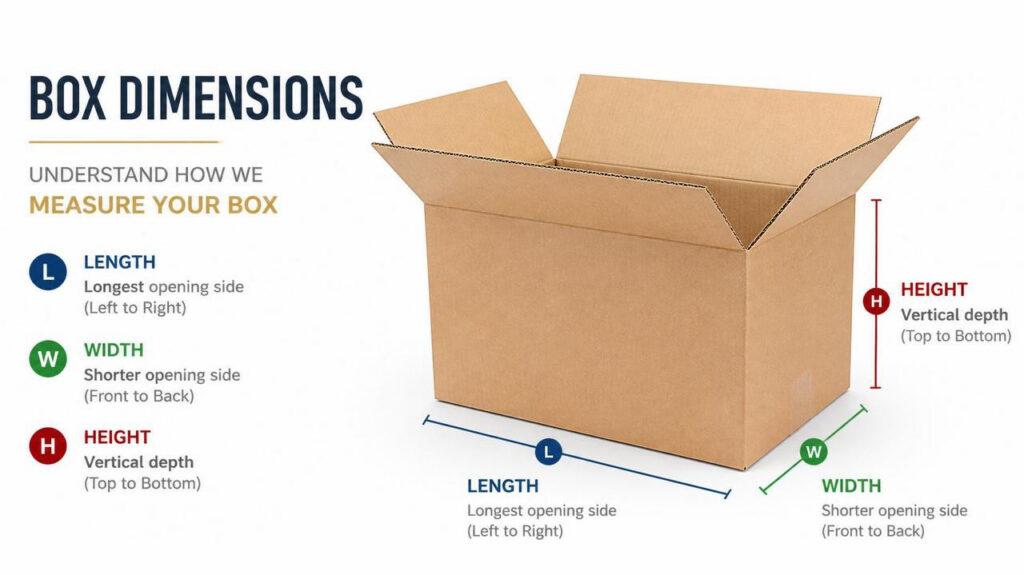
Always Measure in This Order: L × W × H
Boxes are always measured Length × Width × Height:
- Length – the longest side of the opening
- Width – the shorter side of the opening
- Height (depth) – from the opening down to the bottom
Stick to this order and you’ll avoid mix-ups when you’re requesting quotes or comparing sizes across suppliers.
Inside vs. Outside Dimensions
This trips up a lot of buyers. When a supplier lists a box as 12 × 10 × 8 inches, those are almost always the inside dimensions—not the outside.
The reason is simple: corrugated board has thickness.
Inside Dimensions | Outside Dimensions |
Available space for the product | Finished external size of the carton |
Used for packaging design | Used by shipping carriers |
Determines product fit | Determines shipping volume |
Standard measurement in packaging manufacturing | Varies depending on board thickness |
Outside dimensions show how much space the box occupies in transit and billing.
A single-wall box adds roughly 1/8 to 1/4 inch (3–6 mm) to each outside dimension. Double-wall adds even more. That gap matters when your product fits tightly, or when your shipment is close to a carrier’s size limit.
Why Suppliers Use Inside Dimensions
Manufacturers design around inside dimensions because the whole point is making sure your product fits.
Outside dimensions shift depending on flute type, board thickness, tolerances, and how the box is built. So when you’re checking fit, compare your product to the box’s inside measurements—never the outer ones.
Packoi Expert Tip:
One lesson we’ve learned from years of custom packaging projects: customers often send us their exact product dimensions and ask for a box that matches them perfectly. It feels logical, but it leaves zero room for foam, inserts, or manufacturing tolerances—and the product ends up jammed in tight.
So we always work the other way around. We start with the inside dimensions the product actually needs, then build the outer size from the board thickness and construction. It’s a small shift in thinking, but it’s the difference between a box that fits and one that fights the product.
Getting the measurements right is only half the job. Even with the correct inside dimensions, you still need room for the cushioning that keeps your product safe in transit.

How Much Extra Space Should You Leave Inside the Box?
One of the most common mistakes? Picking a box that’s barely bigger than the product.
A snug fit feels efficient, but it leaves no room for cushioning. And your package goes through a lot on the way to your customer—drops, vibration, being stacked under heavier boxes, handling after handling. Without room to cushion the product, even a tough corrugated box can’t keep it safe.
So don’t size the box to your product. Size it to three things:
- Your product’s dimensions
- The cushioning it needs
- Manufacturing tolerance
Think of the box as part of the protection—not just something to hold the product.
Leave Room for Cushioning
How much clearance you need depends on how fragile the product is and what you’re padding it with.
A folded T-shirt barely needs any space. A glass bottle shipped overseas may need foam inserts and a few centimeters of protection on every side. The table below gives you a practical starting point.
Product Type | Recommended Clearance (Each Side) | Typical Protective Material |
Apparel & Textiles | 0.5–1 cm | Tissue paper, poly bag |
Books & Printed Materials | 0.5–1 cm | Kraft paper |
Cosmetics | 1–2 cm | Paper filler, air pillows |
Electronics | 2–3 cm | Foam inserts, EPE foam |
Glass & Ceramics | 3–5 cm | Molded pulp, PE foam |
Industrial Components | 2–5 cm | Foam, corrugated inserts |
Treat these as general guidelines. Odd shapes, sharp edges, or high-value items may need more, depending on how they ship.
A Simple Formula for the Right Inside Size
Instead of guessing, packaging engineers usually run a quick calculation:
Inside Box Size = Product Dimensions + Cushioning Space + Manufacturing Tolerance
For example:
Product size | 10 × 8 × 4 in |
Foam (each side) | 1 in |
Tolerance | 0.25 in |
Recommended inside size | ≈ 12.25 × 10.25 × 6.25 in |
This leaves enough room to protect the product—without the extra empty space that inflates your shipping cost.
Don’t Forget Manufacturing Tolerance
Here’s a detail buyers often miss: no box comes out perfectly to size.
Even high-quality cartons vary a little, because die-cutting, scoring, folding, and gluing all introduce tiny differences. In the corrugated industry, about ±3 mm (±1/8 inch) is normal for most standard box styles.
Ignore that, and you’ll feel it when products fit tightly or your foam inserts are cut with almost no clearance. Leave a little breathing room, and your products will fit the same way across a full production run—not just on the first sample.
How to Choose the Right Box Dimensions for Shipping
No single box size works for every product.
The right choice comes down to balancing four things: protection, shipping efficiency, packaging cost, and the unboxing experience. So before you look at dimensions, look at the whole journey your package takes.
Here are the six factors packaging pros weigh every time.
Start with Product Dimensions
Measure your product first—length, width, and height.
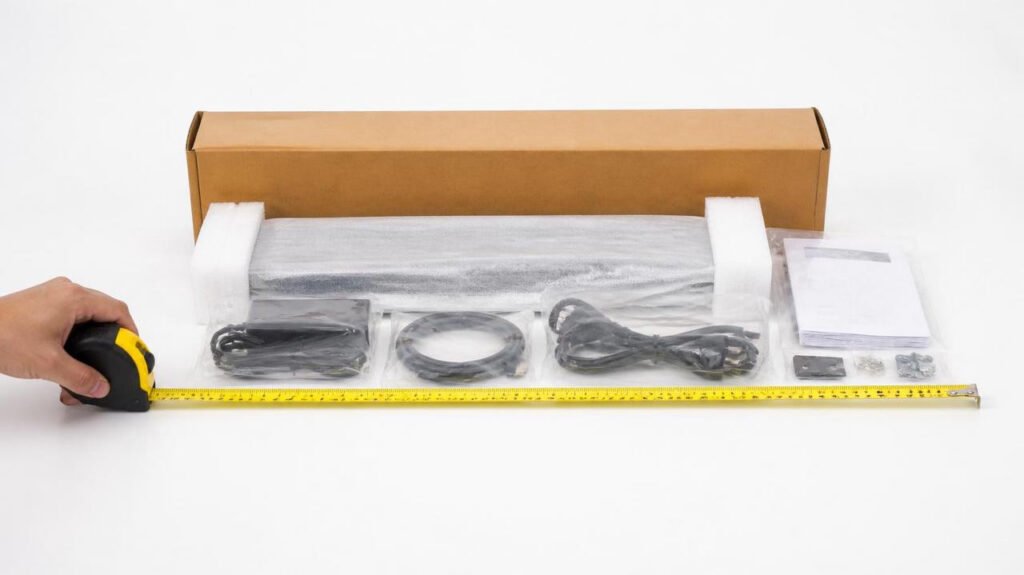
Then ask: are you packing anything else with it? Accessories, manuals, cables, multiple units?
What Product Dimensions Should You Measure?
Measure the product in the same configuration it will have when it goes into the shipping carton. Do not rely only on the dimensions listed on a product page or specification sheet.
For each product, record:
- Length – the longest overall dimension
- Width – the next widest dimension
- Height – the remaining dimension
- Protruding parts – handles, caps, corners, cables, or other parts that extend beyond the main body
- Accessories – manuals, chargers, spare parts, or other items packed in the same carton
For irregularly shaped products, measure from the outermost points rather than the flat surface of the main body. If several units share one box, also decide how they will be arranged before calculating the required inside dimensions.
This gives you a realistic packing footprint instead of a theoretical product size.
If so, measure the packed arrangement as a whole, not each item on its own. Only then should you work out the box size.
Factor in Weight
Weight affects more than your shipping bill. It decides how strong your corrugated board needs to be to survive the trip.
Product Weight | Recommended Board |
Up to 20 lbs | 32 ECT Single Wall |
20–50 lbs | 44 ECT Single Wall |
Over 50 lbs | Double Wall Corrugated |
Heavy Industrial Products | Double or Triple Wall |
Go too strong and you’re paying for board you don’t need. Go too light and the box can crush during stacking or transit.
Think About How Fragile It Is
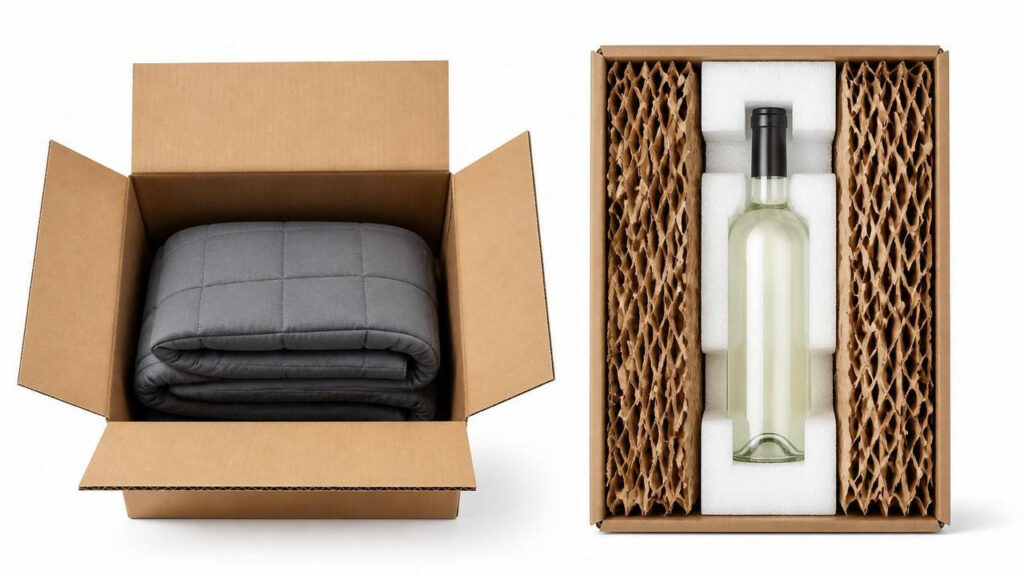
Two products can be the exact same size but need completely different boxes.
A folded blanket handles a little movement just fine. A glass bottle or a lab instrument doesn’t. Fragile items usually need foam inserts, molded pulp trays, corrugated partitions, air cushions, or honeycomb paper. Each of these takes up space—so lock in your internal packaging design first, then size the box around it.
Consider Distance and Transport Method
A local delivery gets handled a few times. An international shipment goes through far more: repeated loading and unloading, long warehouse stays, ocean vibration, air handling, and customs inspections.
The longer the route, the stronger your packaging—and the more clearance—you’ll want. This matters most for export, where replacing a damaged product usually costs far more than beefing up the box.
Check Carrier Requirements
Carriers don’t just move your box—they set the size and weight limits that shape your cost.
Before you finalize a size, check:
- Maximum parcel dimensions
- Dimensional weight pricing
- Oversize thresholds
- Extra handling fees
The major carriers also offer shipping solutions with their own standard packaging options. USPS Priority Mail includes flat rate boxes in standard sizes for shipping. One example is the Small Flat Rate Box at 8⅝ × 5⅜ × 1⅝ in. FedEx also provides box options, including 10 × 10 and 12 × 12 in sizes.
Design within these limits and compare service features like delivery confirmation for sensitive shipments so you’ll dodge surcharges you didn’t see coming.
UPS vs. FedEx vs. USPS: What Box Size Limits Matter?
If you ship regularly in the U.S., it helps to know the basic size limits of the major carriers before you finalize your carton.
Carrier | Max Package Weight | Max Length | Max Length + Girth |
UPS | 150 lbs | 108 in | 165 in |
FedEx Ground | 150 lbs | 108 in | 165 in |
USPS | 70 lbs | — | 108 in for most parcels; 130 in for USPS Ground Advantage |
These are carrier-level limits, not targets for everyday box design. A package can trigger oversize pricing or other fees well before it reaches the absolute maximum. For example, UPS treats domestic packages as large when length plus girth exceeds 130 inches or length exceeds 96 inches, among other criteria.
For most ecommerce brands, the practical goal is simple: keep the carton comfortably below carrier thresholds, enter accurate dimensions, and compare the billable weight before choosing a box size.
Match the Board to the Box
The bigger the box, the more force acts on it. A larger carton carrying the same product faces more compression when stacked and shipped—so size and board strength always go together.
For example:
- A 10 × 8 × 6 in box holding 8 lbs is usually fine in single-wall.
- A 24 × 18 × 18 in carton holding 50 lbs typically needs double-wall for enough stacking strength.
Pick the right board grade and you get durability without overspending.
Common Shipping Box Size Mistakes to Avoid
Choosing a shipping carton is not just about finding one that fits. Small sizing mistakes can increase freight costs, damage risk, and packing time. Before placing a bulk order, check these five common mistakes.
Using Product Dimensions as Box Dimensions
Your product dimensions are the starting point, not the final box size. You still need space for cushioning, inserts, accessories, and manufacturing tolerance.
Measuring the Product but Not the Packed Configuration
A product may fit on its own but not after you add a charger, manual, protective sleeve, or multiple units. Measure the complete arrangement that will actually go inside the carton.
Checking Only the Box Price
A cheaper carton is not always the cheaper packaging option. A slightly larger box can increase DIM weight, filler usage, storage needs, and freight costs. Compare the total cost of the packaging system, not just the unit price.
Ignoring Carrier Limits Until After Production
Do not finalize a carton and check carrier requirements later. Confirm maximum dimensions, oversize thresholds, dimensional weight rules, and handling fees before approving the final box specification.
Ordering Large Quantities Before Testing the Fit
A box can look right on paper and still fail in real packing. Test the product, cushioning, closure, stacking, and shipping configuration before committing to a large production run. A physical sample can reveal problems that a dimension sheet cannot.
Standard vs. Custom Shipping Boxes
Once you’ve nailed down the right size, the next question is simple: will a standard stock box do the job, or is it worth investing in custom?
There’s no one right answer. It comes down to your product, your shipping volume, your branding, and your long-term logistics cost.

When a Standard Box Makes Sense
Stock boxes come pre-made in common sizes, and almost every distributor carries them.
They’re usually the smart choice when:
- You’re launching a new product and your packaging might still change
- Your order volumes are still low
- You need boxes fast, and branding isn’t the priority
- Your product already fits a stock size well
Because they’re mass-produced, stock boxes cost less upfront and ship quickly. The trade-off: they won’t always fit your product perfectly.
When Custom Pays Off
Custom boxes are built to your exact product and packaging needs.
The tooling and setup cost more at first, but the math tends to flip as your volume grows. Custom is worth it when you want to:
- Cut dimensional weight charges
- Protect the product better
- Use less filler
- Present your brand
- Pack faster
- Fit more onto each pallet or into each container
If you ship hundreds or thousands of packages a month, even shaving an inch off the box can add up to real savings over time.
Standard vs. Custom at a Glance
Factor | Standard Boxes | Custom Boxes |
Initial Cost | Lower | Higher |
Lead Time | Short | Longer |
Product Fit | General-purpose | Tailored to the product |
Shipping Efficiency | Moderate | Higher |
Branding Options | Limited | Fully customizable |
Material Usage | Often higher | Optimized |
DIM Weight Optimization | Limited | Excellent |
Best For | Small businesses, low-volume shipments | Growing brands, manufacturers, high-volume shipping |
Don’t just compare the price of the box itself. Look at the total cost—freight, storage, labor, and damaged product. More often than not, a well-designed custom box delivers more long-term value than a cheaper stock carton.
A Quick Decision Guide
Business Situation | Recommended Option |
Testing a new product | Standard shipping box |
Shipping low monthly volumes | Standard shipping box |
Products fit common box sizes | Standard shipping box |
Fragile or irregularly shaped products | Custom shipping box |
High shipping volumes | Custom shipping box |
Looking to reduce DIM weight | Custom shipping box |
Building a premium brand experience | Custom shipping box |
Frequently Asked Questions About Shipping Box Size
Q1:What size shipping box do I need for my product?
Start with your product’s measurements, then add room for cushioning and a small manufacturing tolerance—not the other way around. For most products, trimming each side to just 1–2 inches larger than the product (with enough padding to protect it) gives you the best fit. The right box hugs your product as tightly as protection allows.
Q2:How do I choose the right shipping box size?
Weigh six things: your product’s dimensions, its weight, how fragile it is, how far and how it ships, your carrier’s size rules, and the board strength you need. Don’t grab the closest box on the shelf—size it to protect the product while keeping empty space (and shipping cost) to a minimum.
Q3:How much bigger should a shipping box be than the product?
It depends on how fragile the product is. Durable, non-fragile items need very little clearance. Fragile items—glass, electronics, cosmetics—usually need cushioning space on every side. A simple rule: Inside Box Size = Product Dimensions + Cushioning Space + Manufacturing Tolerance. That leaves enough to protect the product without inflating your freight bill.
Q4:Do bigger boxes cost more to ship?
Often, yes—even for the same product. Carriers like UPS and FedEx charge by dimensional (DIM) weight, which prices the space your box takes up, not just its weight. So a big box holding a light item can cost far more than a right-sized one. Shrink the box, shrink the DIM weight.
Q5:Should I use a standard box or a custom box?
Standard boxes win when you’re launching a new product, your volumes are low, or you need boxes fast. Custom boxes pay off as volume grows—they cut DIM charges, reduce filler, protect better, and fit more onto each pallet. Compare total cost (freight, storage, labor, damage), not just the price of the carton.
Q6:How much cushioning space should I leave?
Enough to absorb drops, vibration, and stacking. A folded T-shirt needs almost none; a glass bottle shipped overseas may need foam and a few centimeters on every side. The more fragile or valuable the product, the more clearance it needs. Size the box to fit the product and its cushioning—not the product alone.
Conclusion
Choosing the right shipping box size isn’t just about finding a carton that fits—it’s about balancing protection, shipping cost, and customer experience.
Get it right and a well-sized box does a lot of quiet work: it lowers your freight bill, wastes less material, moves faster through your warehouse, and gives your customer a better unboxing. As carriers keep pricing by dimensions and supply chains push toward sustainability, right-sized packaging is turning into a real competitive edge.
So if your products don’t fit standard sizes, or you sense there’s room to ship smarter, it’s worth taking another look at your packaging.
Optimize Your Shipping Boxes with Packoi
Packoi designs and manufactures custom corrugated packaging that balances protection, shipping efficiency, and brand presentation. From structural engineering and custom printing to large-scale production, we help brands worldwide recommend the right box size, board grade, and structural design for their products.
Looking for the ideal shipping box for your products? Talk to our packaging specialists today or request a custom quote.